There was a time when India’s proposition to the global enterprise was rooted in efficiency. Its scale of talent, competitive operating costs and growing services ecosystem made it an attractive extension of businesses looking to streamline operations and deliver at scale. Over time, however, the capabilities built around that proposition began to create something larger: a deeper pool of expertise, stronger technology ecosystems and the institutional knowledge to take on increasingly complex work.
Today, that foundation is changing the nature of India’s role in the global enterprise. The question is no longer simply how efficiently work can be delivered from India, but how much of the enterprise’s next chapter can be conceived, developed and scaled from here. That shift sits at the heart of India’s GCC story.
The world is redistributing capability
This shift is taking place against a broader reorganisation of the global economy. Supply chains are being reconsidered, technology is changing the economics of knowledge work, and enterprises are becoming more deliberate about where they place the capabilities that will shape their next products, platforms and businesses.
China continues to be a critical industrial powerhouse, while Vietnam has emerged as an important node in the diversification of global manufacturing and supply chains. India’s opportunity sits within this wider redistribution of capability, but it is not simply about replacing one geography with another. It is about occupying a more valuable position in the global value chain.
The differentiators are increasingly extending beyond operating costs. Talent density, digital infrastructure, specialised expertise, innovation ecosystems and the ability to develop solutions for global markets are becoming equally important. This is also reflected in India’s rising position across global innovation and competitiveness measures. The country is increasingly being evaluated not only for what it can execute, but for what it can originate.
India’s Rising Enterprise Value
That changing perception is already visible in the evolution of India’s Global Capability Centres. What began largely as a model for locating established processes in a more efficient operating environment has developed into something far more consequential.
India now has more than 2,000 GCCs employing millions of professionals, with these centres increasingly taking ownership of global functions across technology, engineering, research, product development, analytics and business operations. The significance lies not simply in their scale, but in the nature of the responsibility being entrusted to them.
There is a fundamental difference between managing a process and owning an outcome. One creates operational efficiency; the other creates knowledge, intellectual property and enterprise capability.
As more organisations give their Indian centres responsibility for products, platforms, research and strategic functions, the GCC moves closer to the centre of enterprise creation. It is no longer simply an extension of where work happens. It is becoming part of where the enterprise decides what happens next.
When enterprise ambition becomes physical
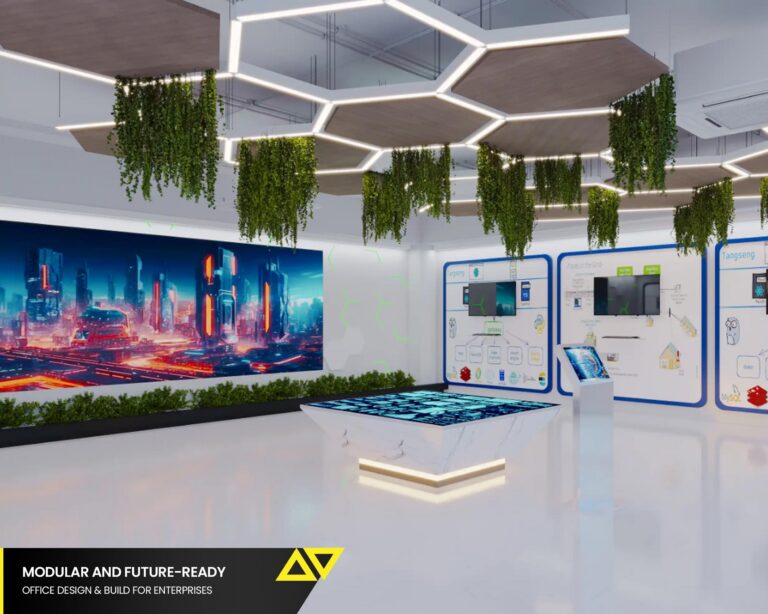
If the GCC is becoming a more strategic part of the enterprise, its workplace has to evolve with it. A centre shaping global products, research and innovation needs an environment that allows ideas to move as fluidly as the people behind them, from focused individual work to cross-disciplinary collaboration, informal exchange and experimentation.
That means thinking beyond the conventional office and designing an environment that anticipates how the enterprise will work next. Technology infrastructure must be ready for emerging needs, spaces must adapt as teams and ways of working change, and the workplace must create opportunities for interaction without making collaboration feel programmed. Focus, exchange and experimentation need to coexist as part of the same ecosystem.
The ambition is not to create a more impressive office. It is to create a space that gives a more ambitious enterprise the conditions to do its best work.
Making India a hub for product conceptualisation
India’s GCCs are becoming places where global capabilities converge, bringing technology, engineering, research and product expertise closer to the decisions that shape the enterprise. AI is accelerating this convergence, making cross-functional thinking and collaboration increasingly central to how new ideas take shape.
The GCC is therefore becoming a more integral part of the enterprise itself, and its physical environment needs to reflect that shift.
When enterprise ambition becomes physical
A GCC responsible for global products, research or innovation needs more than a conventional office. It needs environments that support focused work, cross-disciplinary collaboration, experimentation and the movement from idea to execution.
Technology infrastructure needs to anticipate what comes next. Spatial planning needs to accommodate changing teams and ways of working. The workplace needs to enable the enterprise, not simply house it.
Designing ahead of the brief
That shift calls for a different approach to the workplace itself. A GCC with a distinct mandate cannot be served by a standardised workplace formula. Its environment needs to reflect the capabilities it is building, the technology it is adopting and the way its teams are expected to work.
At Flipspaces, we bring design, sourcing, technology and execution together on one integrated, technology-enabled platform, allowing each of these considerations to inform the environment as a whole. The result is not simply a workplace built for today, but one shaped around where the GCC is headed next.
India’s next GCC advantage
India’s first GCC advantage was the ability to execute global work at scale. Its next could be something far more consequential: becoming a place where global enterprises create their next advantage.
As product ownership, technology, research and strategic responsibility deepen in India, GCCs are becoming part of the machinery that shapes what an enterprise does next. They are not simply carrying the global enterprise forward. They are helping define its direction.
The spaces they occupy need to do the same, moving from environments that support work to environments that enable what comes next.
Frequently Asked Questions