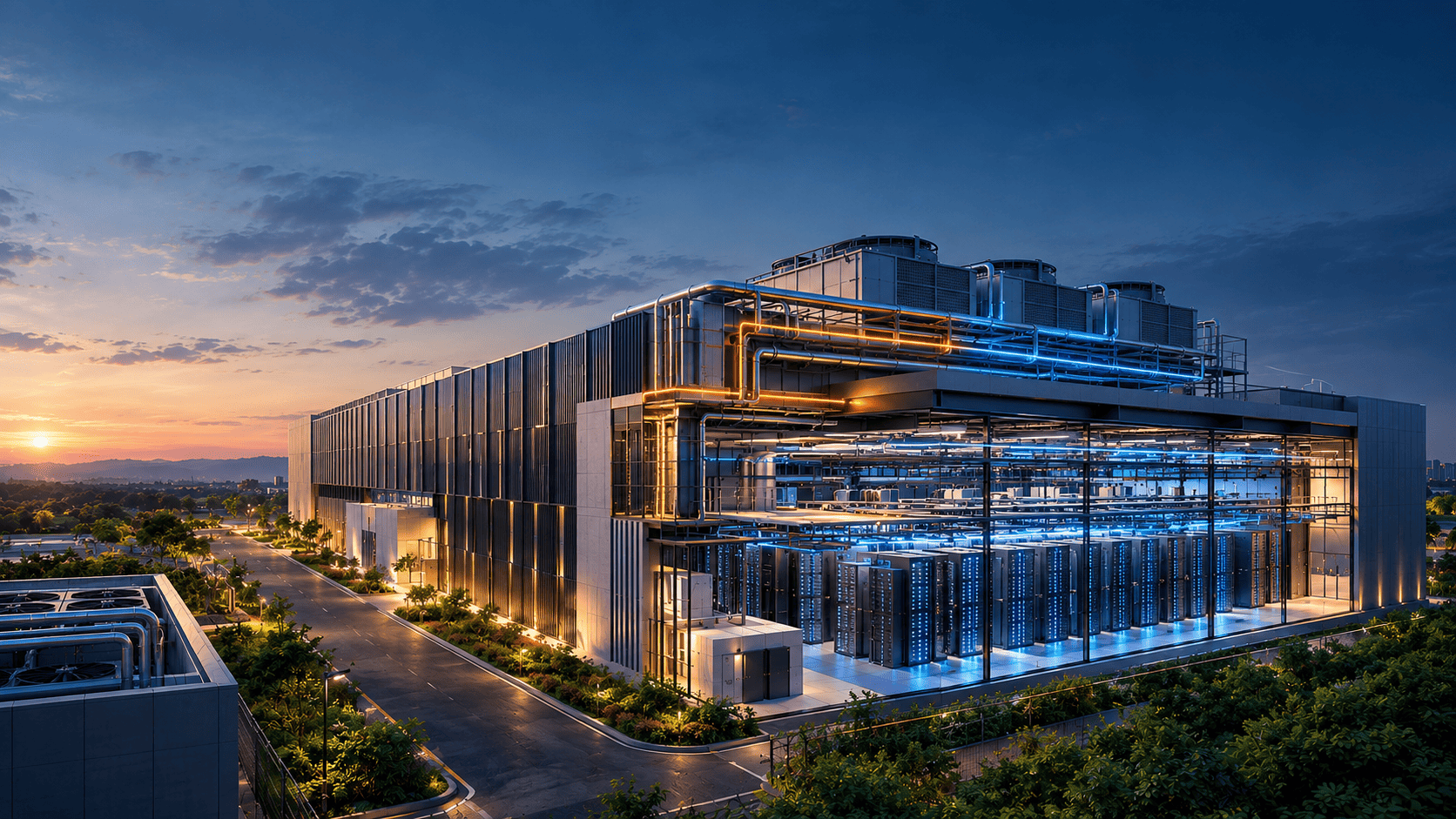
Every search, transaction, stream, conversation and increasingly every interaction with AI depends on something remarkably physical: a space built to store, process and move data. Behind the apparent weightlessness of our digital lives sits an increasingly sophisticated physical infrastructure, built to handle enormous volumes of information, uninterrupted computing and the growing demands of AI.
That infrastructure is reaching a point where the old relationship between technology and space no longer holds. The International Energy Agency’s Energy and AI report projects that global data-centre electricity consumption will more than double to around 945 TWh by 2030, with electricity use by AI-driven accelerated servers growing by around 30% annually.
These numbers are not simply an engineering challenge. They are a design brief.
The next generation of data centres cannot be designed as buildings that contain computing. They have to be designed as physical systems that enable computing.
When the building becomes part of the compute
For much of the data centre’s history, the primary challenge was creating a controlled, reliable environment in which computing equipment could operate continuously. Architecture and infrastructure were largely organised around that requirement.
AI is changing the relationship between the technology and the environment that supports it. Uptime Institute’s Global Data Center Survey 2025 found that 82% of surveyed facilities still have no racks above 30 kW, but 9% already report racks at 50 kW or higher, with some exceeding 100 kW. The survey also finds that HPC and AI become the dominant drivers of rack density above 60 kW.
That matters because density changes the building itself. ASHRAE’s AI Data Center Energy Performance Framework notes that AI and HPC are pushing rack densities from roughly 120 kW towards several hundred kilowatts, with megawatt-class racks anticipated in the near term. It explicitly argues that these conditions invalidate many legacy assumptions around power delivery, cooling and physical infrastructure.
Power distribution, cooling, structural capacity, rack layouts, service routes and expansion can no longer be resolved independently. ASHRAE recommends designing architectural, electrical and mechanical systems as a single, interdependent system. This is where integrated design and build solutions become essential, bringing these interdependent requirements together from the outset.
Architecture is no longer the container around the technology. It is part of the technology’s operating system.
A square metre has to earn its place
That changes the meaning of spatial efficiency. The objective is not simply to put more racks into less floor area. It is to make every part of the facility contribute to performance.
Higher density can increase computing capability without proportionally increasing footprint, but only when the surrounding infrastructure is designed to support it. ASHRAE’s research notes that AI racks are becoming significantly heavier, while extensive liquid-cooling networks are creating new requirements for structural capacity, leak detection, zoning and containment.
Space is therefore no longer a passive measure of capacity. It becomes an active variable in performance.
A better data centre places density where power and cooling can serve it effectively, plans access around actual operational requirements and creates expansion capacity without building large amounts of redundant space. This calls for precise commercial space planning that accounts for equipment layouts, technical infrastructure, maintenance access and future expansion.
The goal is not smaller for the sake of smaller.
It is more computing capability from a better-performing physical environment.
When Heat Becomes a Design Parameter
The thermal challenge is changing the architecture of the data centre itself. Cooling is no longer a downstream engineering service. As AI and HPC push rack densities into the hundreds of kilowatts, power delivery, heat rejection, structural loading and spatial planning have to be resolved as one system.
ASHRAE’s AI Data Center Energy Performance Framework identifies direct-to-chip liquid cooling as a key approach for high-density compute, with higher-temperature liquid cooling offering the potential for chiller-less heat rejection and lower water use in suitable climates. Its analysis also indicates that integrated liquid-cooled designs can achieve PUE values near 1.10, compared with roughly 1.4 to 1.6 for more conventional facilities.
The design implication is clear: heat has to become an architectural parameter from the outset. Where high-density compute is located, how thermal zones are organised, how cooling infrastructure is distributed and how systems are accessed for maintenance all influence the performance, efficiency and adaptability of the facility. Technology-driven design solutions must account for these relationships from the beginning, ensuring that the building, power and cooling systems work as a single performance architecture.
Build for active change, not projection
There is another problem with designing around today’s specification: today’s specification will not stay today’s specification.
ASHRAE’s research highlights that chip roadmaps, cooling technologies and power architectures are evolving faster than traditional design cycles. Its recommendation is therefore not simply to design for today’s requirements, but to balance immediate performance with long-term adaptability.
Uptime Institute’s Global Data Center Survey 2025 similarly identifies unpredictable technological advances, power constraints and the challenge of meeting AI density requirements among the industry’s growing concerns.
Future-ready design therefore cannot mean guessing the next generation of hardware correctly.
It means giving the building enough flexibility to absorb it. Modular infrastructure, scalable power and cooling, adaptable layouts and planned expansion can turn the facility from a fixed response to today’s hardware into a platform for tomorrow’s compute. These are the principles behind future-ready spaces, designed to accommodate evolving technologies without requiring extensive reconstruction every time computing requirements change.
You cannot future-proof a data centre by predicting the future. You future-proof it by designing for change.
Planning a facility where power, cooling and structure have to resolve together?
Talk to our team about getting those decisions right at the design stage, while they are still cheap to change.
The real efficiency equation
This is ultimately why the architectural question matters.
Data centres are becoming a significant part of the world’s energy infrastructure. The IEA’s Energy and AI projects global data-centre electricity consumption to reach around 945 TWh by 2030, with data-centre electricity demand growing around four times faster than total electricity demand from all other sectors between 2024 and 2030.
Efficiency therefore cannot be solved by improving servers, cooling equipment or power systems in isolation.
The PNNL/ASHRAE/NEMA AI Data Center Energy Performance Framework now covers planning, siting, integrated design, energy and thermal efficiency, grid interaction, resilience, commissioning and operations as interconnected aspects of AI data-centre performance. This reinforces the importance of coordinating commercial architecture and interior design with the engineering systems, technical requirements and operational demands that determine how a facility performs.
That is the larger shift.
The physical environment is part of the efficiency equation.
Not a larger building for larger workloads, but a more intelligent physical system in which space, power, heat, infrastructure and adaptability are designed together.
At Flipspaces, this sits within a broader belief in building the future of spaces. For data centres, that future begins when design stops treating technology as something that occupies a building and starts treating the building itself as part of how technology performs. Our approach brings together integrated design and build solutions and turnkey design and build services to align the physical environment with the demands of modern computing, from infrastructure planning to execution.
Because the future of computing will be built not only with better processors, models and data, but in spaces designed to make all three work better.
As AI reshapes the demands on digital infrastructure, the opportunity lies in designing data centres where space, power, cooling and technology work as one. At Flipspaces, we bring design, sourcing and execution together to build high-performance environments engineered for the demands of computing today and the possibilities of tomorrow.
Frequently Asked Questions