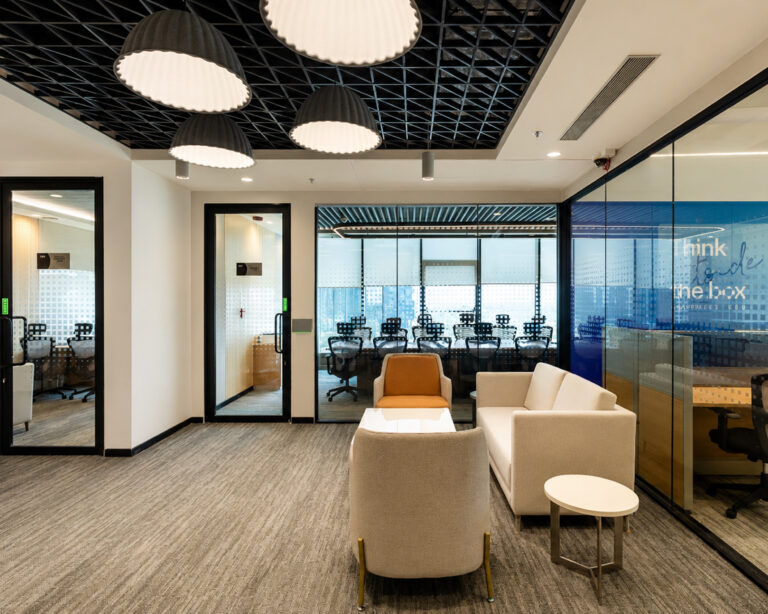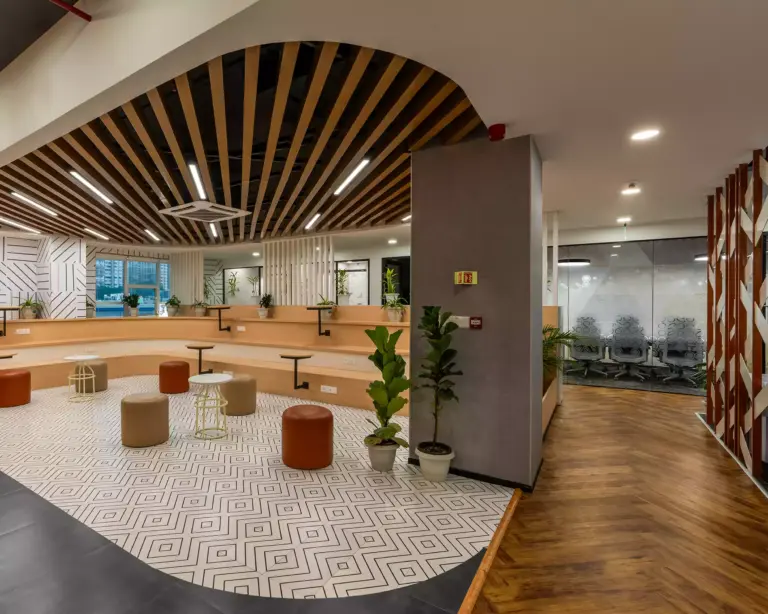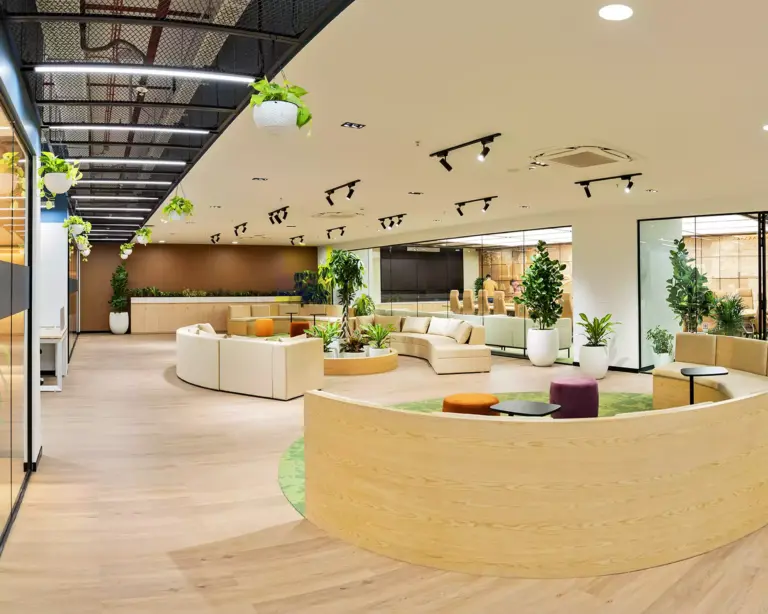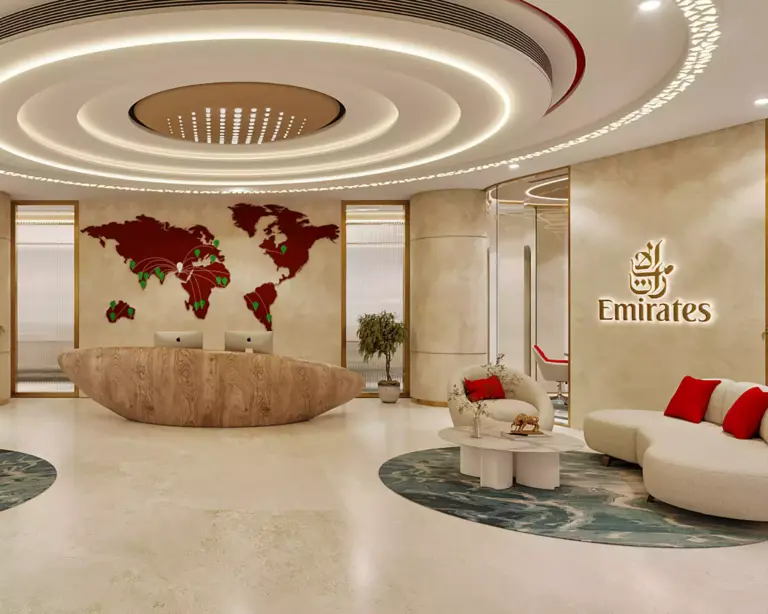
In Brief: India now hosts 2,117 Global Capability Centres employing 2.36 million people. GCCs leased over 31 million sq ft of Grade A office space in 2025 and set consecutive quarterly records through the first half of 2026, taking 42% of all office take-up in Q2. Roughly three-quarters of that leasing went into green-certified buildings. The brief for a GCC office has changed fundamentally. What was once a seat-and-desk exercise is now a strategic decision that shapes how well a centre attracts talent, meets global ESG commitments, supports hybrid work and holds brand consistency across cities. This guide covers what GCCs are building in 2026 and what any new or expanding centre needs to get right in its workspace design.
What is a GCC?
A Global Capability Centre is a captive unit set up in India by a global company to run strategic functions ranging from technology development and data analytics to finance, legal and product engineering. Unlike an outsourcing arrangement, a GCC is wholly owned by the parent company. India hosts more of them than any other country in the world.
The Scale of What Is Happening
To understand why GCC office design has become a specialised discipline, you need to understand what India’s GCC ecosystem actually looks like in 2026.
Nasscom and Zinnov reported in July 2026 that India hosts 2,117 GCCs operating across 3,728 units and employing around 2.36 million professionals. Ecosystem revenue stands at USD 98.4 billion. The number of GCCs has grown by 32% since FY2021, and an estimated 506 companies in the Forbes Global 2000 now run operations from India. Engineering, research and development centres continue to grow faster than the ecosystem as a whole, which matters for design because those are the briefs with the most demanding physical requirements.
Source: Nasscom and Zinnov, GCC Value Orbit, July 2026; Zinnov, India GCC Landscape 2026
That ecosystem growth shows up directly in real estate. JLL records GCCs leasing over 31 million sq ft in 2025, the highest annual figure on record and 37.7% of all gross leasing. Roughly 200 new GCCs entered the country over the two years to the end of 2025, and GCCs now account for close to half of all active space requirements in the market.
Source: JLL India Office Market Dynamics
Momentum accelerated through the first half of 2026. CBRE recorded a record GCC leasing of 9.1 million sq ft in Q1, then a new record of about 10.3 million sq ft in Q2, with GCCs accounting for 42% of total office take-up and gross leasing hitting an all-time quarterly high of around 24.6 million sq ft. JLL put the GCC share of Q1 gross leasing at 45.5% and reported vacancy across India falling to 14.7%, the lowest in five years.
Source: CBRE India Office Figures Q2 2026; CBRE India Office Figures Q1 2026; JLL India, Q1 2026 office market release
Sustainability is now a filter rather than a preference. CBRE found 79% of Q1 2026 leasing and 73% of Q2 2026 leasing concentrated in green-certified assets, with 76% of new Q2 completions green-certified. Colliers expects green-certified and tech-integrated buildings to account for close to 80% of all leasing in 2026, and projects GCC leasing of 30 to 35 million sq ft for the year, representing 40 to 50% of Grade A demand.
Source: CBRE India Office Figures Q2 2026; Colliers, 2026 India Office Outlook
This is not background context. It is the operating environment in which every GCC office design decision is made. Space is competitive, green-certified supply is finite, and the design brief is now the front line of talent strategy.
What Has Changed in the GCC Office Brief
Ten years ago, a GCC office brief was a headcount exercise. How many people, how many desks, how many meeting rooms. The fit-out came after the lease was signed, often as an afterthought. That model has stopped working. Here is what has replaced it.
1. Seat ratios have changed:
Most well-planned GCCs in India now design for roughly 0.7 to 0.85 seats per employee rather than one desk per head, because hybrid attendance patterns no longer justify a full seat for everyone. Hybrid policy sets the seat ratio, and the design consequence is a shift away from fixed assigned desks towards neighbourhood zoning, bookable focus rooms, hot-desking systems and sensor-driven utilisation tracking. Planning assumptions of 50-60% occupancy on any given day are now common.
2. Green certification has moved from optional to expected:
LEED Platinum and WELL are no longer differentiators. They are baseline requirements written into the brief before design begins, because global parent companies increasingly treat certification as a shortlisting condition rather than a nice-to-have. The market data confirms how far this has gone, with roughly three-quarters of all Indian office leasing now landing in certified assets. Any centre choosing non-certified Grade B space in 2026 is making a deliberate trade-off against ESG commitments, talent perception and long-term asset value.
Source: CBRE India Office Figures Q2 2026; Colliers, 2026 India Office Outlook
3. Data security requirements are shaping floor plans:
With India’s Digital Personal Data Protection Act in force and many GCCs running internal AI models and regulated data workloads, secured zones, biometric access layers and segregated AI labs have become standard requirements. These are structural decisions. Retrofitting them into a completed fit-out is substantially more expensive than building them in from the start, and in some buildings it is not possible at all without renegotiating the lease.
4. Talent competition has raised the design expectation bar:
GCC offices are increasingly designed with curated cafes, wellness zones, nursing and lactation rooms, nature-integrated environments and acoustic solutions for neurodiverse teams. These are retention tools written into the brief, not perks added after the budget is set. With GCCs competing for the same senior engineering and analytics talent in the same handful of micro-markets, the physical environment has become part of the offering.
The Six Cities and What Each Requires
GCC office design is not uniform across India. Each city’s talent pool, building stock and industry composition shapes what a space needs to do. The published leasing and supply data shows how differently these markets behave.
Bengaluru:
Bengaluru remains the dominant GCC market. In Q1 2026, it took 24.8% of national leasing, with GCCs making up 70% of that, the highest in two years. CBRE ranked it first among cities again in Q2 at 27%. Bengaluru also drew close to a third of all foreign-occupier leasing in Q1, more than any other city. Mumbai led overall leasing at 30%, but that is Cushman and Wakefield’s all-occupier count, a different measure. Colliers expects Bengaluru to account for close to a third of both leasing activity and new supply in 2026. The design brief here favours high-density but high-quality fit-out, strong collaboration infrastructure for product teams, and green certification as a hiring signal to a sophisticated talent pool.
Source: JLL India, Q1 2026 office market release; CBRE India Office Figures Q2 2026; Colliers, 2026 India Office Outlook
Hyderabad:
Hyderabad took a 14% share of Q1 2026 leasing across the top eight cities, and Colliers expects it to record over 10 million sq ft of both demand and new supply across 2026, putting it alongside Delhi-NCR as a second-tier-one market in its own right. Its occupier mix is broader than technology alone, with financial services and life sciences both well represented, so briefs here vary more by sector than in Bengaluru.
Source: Cushman and Wakefield, India Office Market Q1 2026; Colliers, 2026 India Office Outlook
Delhi-NCR:
Delhi-NCR, including Gurgaon and Noida, ranked among the top three markets alongside Bengaluru and Mumbai through H1 2026, with the three together accounting for 61% of total absorption. Colliers expects the region to see 10 million sq ft of demand this year. The GCC brief here often carries a prestige dimension, with proximity to corporate headquarters, client-facing spaces and designs that communicate leadership credibility alongside technical depth.
Source: CBRE India Office Figures Q2 2026; Colliers, 2026 India Office Outlook
Mumbai:
Mumbai led overall office leasing in Q1 2026 with a 30% share, per Cushman and Wakefield, and remained in the national top three through H1. That share covers every occupier type, not just GCCs, and is where Bengaluru maintains its lead. Mumbai’s GCC demand is concentrated in BFSI and capital-intensive analytics, and it is the most expensive market in the country to occupy, so the brief here is under constant pressure to optimise square-foot efficiency while maintaining a premium appearance appropriate for financial services clients.
Source: Cushman and Wakefield, India Office Market Q1 2026; CBRE India Office Figures Q2 2026
Pune and Chennai:
Both are absorbing the next wave of GCC setups, driven by cost and talent arbitrage relative to Bengaluru. Pune was among the three largest supply markets in both Q2 and H1 2026, alongside Bengaluru and Ahmedabad, and Chennai was among the leading supply contributors in Q1. Pune skews towards automotive engineering, BFSI technology and embedded systems. Chennai carries a client mix spanning automotive OEMs, pharma companies and global banks. Both benefit from newer building stock, which makes certification targets easier to hit.
Source: CBRE India Office Figures Q2 2026; CBRE India Office Figures Q1 2026
Tier 2 cities:
Tier 2 activity is no longer speculative. Ahmedabad ranked among India’s top three supply markets in both Q2 and H1 2026, which is a structural shift rather than a quarterly anomaly, and GIFT City has given the region a regulatory draw that other Tier 2 markets do not have. Coimbatore, Kochi and Vadodara are seeing measurable GCC activity on the strength of lower costs and improving talent pools. The design implication is that Tier 2 briefs are increasingly held to Tier 1 specification standards because the parent company applies a single global workplace standard regardless of the city.
Source: CBRE India Office Figures Q2 2026
What the GCC Office Design Brief Actually Contains in 2026
A GCC office brief in 2026 is more complex than any standard commercial office brief. Here is what it typically covers.
1. Seat ratio and headcount planning:
Not just how many people today, but what the centre will look like in 18 to 36 months. Most GCC leases run for five to nine years, and the design must accommodate planned growth without a full refit.
2. Hybrid work infrastructure:
Activity-based environments, micro-zones for deep focus, video-conferencing-ready meeting rooms at every scale, hot-desking with booking technology, and enough collaboration space to make coming in worthwhile without a mandate.
3. ESG and green certification requirements:
Which certification, to what level, by when. LEED Platinum is increasingly the target. IGBC Green Interiors and WELL are also common requirements. Materials specification, energy systems, water efficiency and waste management all flow from the certification target, which is why it has to be fixed before design starts rather than after.
4. Global brand consistency with local identity:
A GCC is part of a global organisation. The workspace has to feel consistent with the parent company’s global design language while also reading as a place that belongs in India. Getting that balance right requires designers who understand both contexts.
5. Data security and compliance zoning:
Secured areas, biometric access, segregated server rooms and, in some cases, physically separated AI development environments. These requirements have to be resolved in the design and the structure, not added after handover.
6. Wellness and hospitality-grade amenities:
Not a list of perks but a recruitment and retention strategy expressed through design. GCCs that have invested here report measurable impact on offer acceptance and employee tenure.
7. Future-readiness and modularity:
A GCC expecting to grow from 200 to 800 seats over a lease term needs modular layouts, flex density and infrastructure that can be reconfigured without civil work. A space planned to evolve does not strand real estate or force an expensive mid-lease refit.
What Different Industries Are Building
GCCs are not a single category. Design requirements vary significantly by the parent company’s industry, and the sector mix of Indian office demand shows how broad the base has become. In Q2 2026, flex operators led leasing at 27%, followed by technology companies at 21% and BFSI at 13%. In Q1, IT-BPM led at 23%, BFSI followed at 21%, and engineering and manufacturing took 15%.
Source: CBRE India Office Figures Q2 2026; Cushman and Wakefield, India Office Market Q1 2026
Technology and IT GCCs build for developer-first environments. That means structured quiet zones for deep focus, product team war rooms, collaborative sprinting spaces, recreation areas that now function as recruiting tools, and high-density floor plans that do not compromise acoustic quality.
BFSI GCCs require compliance-first environments. Trading floor acoustics, segregated compliance zones, client-facing boardrooms, regulated data infrastructure and a design language that communicates stability and authority. BFSI has been one of the two largest demand drivers in Indian office leasing through 2026, and international banking and financial services firms setting up offshore operational hubs are a major part of the current GCC wave.
Source: JLL India Office Market Dynamics
Engineering, research and development centres are growing faster than the broader GCC ecosystem. These spaces need lab adjacencies, flexible project team areas and prototyping zones that standard office fit-outs do not accommodate. The R and D brief is also the most likely to require Platinum-level certification.
Source: Nasscom, India GCC Landscape Report
Healthcare and life sciences GCCs are among the most significant non-technology segments in the ecosystem. These spaces carry specific requirements around controlled-access environments, regulatory compliance infrastructure, clinical data security zoning and biometric access to sensitive data.
The Multi-City Challenge
Very few large GCCs operate from a single location. Most run primary operations in one or two Tier 1 markets with satellite setups elsewhere, and the Nasscom and Zinnov data, showing 2,117 GCCs spread across 3,728 units, make the point plainly. On average, each GCC now runs close to two sites.
Source: Nasscom and Zinnov, GCC Value Orbit, July 2026
Managing a consistent design language across a Bengaluru headquarters, a Hyderabad analytics centre and a Pune engineering outpost is genuinely difficult. It requires a design-build partner who can deliver to the same quality standard across cities simultaneously rather than sequentially. Procurement consistency matters as much as design quality here.
The practical challenges are specific. Material specifications need to be uniform across vendor ecosystems that vary considerably by city. Brand consistency has to hold in the details employees notice daily, meaning furniture, wayfinding, lighting character and reception design, without a site-by-site redesign process. A single point of accountability must exist for a client whose real estate team coordinates across multiple cities and time zones.
This is a fundamentally different ask from a single-city office project. It requires national delivery capability, technology that enables remote oversight of multiple sites simultaneously, and a procurement ecosystem that operates consistently across geographies.
What Flipspaces Brings to GCC Office Projects
Flipspaces has designed and built commercial interiors for GCC clients across Bengaluru, Mumbai, Hyderabad, Chennai and Delhi-NCR, including multi-city rollouts for the same organisation across four locations simultaneously.
The GCC brief demands spaces that perform, not spaces that merely look good. Our technology platform is built around that outcome. VIZWORLD is the proprietary stack that connects design, sourcing and execution into a single workflow, and three modules of it matter most on a GCC project.
VIZWALK, our 3D walkthrough tool, lets GCC leadership and global stakeholders experience a space before civil work begins. That resolves design alignment across geographies without requiring everyone on site, and it eliminates the expensive changes that surface after construction has started.
VIZCART is our product selection platform, featuring a curated catalogue of over 200,000 products and finishes, benchmarked for quality, pricing, and delivery timelines. In a multi-city GCC rollout, this is the module that does the heaviest lifting, because it ensures that a workstation in Bengaluru and a workstation in Pune arrive to the same specification, rather than whatever each local vendor ecosystem happens to stock.
VIZCLIENT gives clients real-time project visibility through remote site monitoring and design-to-actual tracking, so progress decisions are made based on data rather than calls and emails.
The result is a space that is future-ready. Built to accommodate growth without a full refit, designed to meet the ESG certifications the parent company requires, and instrumented well enough to give you utilisation data from day one.
A GCC office is no longer a cost centre to fit out. It is an intelligent, future-ready environment that has to perform. That is what we build. If you are setting up a new GCC or expanding an existing one, we would like to talk.
A GCC Office That Performs
India’s GCC sector has moved from a growth phase into a sophistication phase. The centres being set up in 2026 are strategic innovation hubs, and the physical workspace is now recognised as a core part of that strategy.
Getting the design right means asking the right questions at the brief stage. Seat ratios, green certification, data security zoning, hybrid infrastructure and multi-city consistency. These are business decisions that affect talent acquisition, retention, ESG reporting and the productivity of the entire centre.
If you are setting up or expanding a GCC in India and want to talk through the workspace design brief, get in touch with the Flipspaces team.