In Brief: Technology firms are India’s largest office occupiers. In 2025, tech maintained its position as the full-year leader in office leasing, with a 25.8% share of total leasing volumes, and in Q1 2026, tech emerged as the largest contributor, with a 29.1% share. The IT office brief in India has changed considerably. It is no longer a floor of workstations and a few meeting rooms. It is a designed environment built to attract and retain engineers in a competitive talent market, support hybrid work patterns, and signal to the world what kind of company this is. This guide covers what India’s technology companies are building right now and what the IT office design brief looks like in 2026.
The Numbers Behind the IT Office Market
India’s technology sector does not just generate software. It generates office demand at a scale no other industry in the country comes close to. In 2025, tech maintained its position as the full-year leader in office leasing with a 25.8% share of total leasing volumes across India’s top cities, as total gross leasing reached a record high of 83.3 million sq ft.
Bengaluru anchored that record. The city posted its best-ever year, with 24.1 million sq ft of gross leasing, up 9.8% year on year, and held a 29% share of national leasing, cementing its status as the undisputed destination for global firms. Those global occupiers accounted for 58.4% of all leasing in 2025, the demand base behind much of the country’s new technology office space.
Source: JLL India Office Market Full Year 2025
The momentum has continued into 2026. In Q1 2026, India’s office market recorded 21.5 million sq ft of gross leasing, the highest ever for any first quarter, with the tech sector emerging as the largest contributor at 29.1%.
Source: JLL India Office Market Q1 2026
This scale matters because it sets the context for what companies are designing. When a technology firm signs a 9-year lease on 50,000 sq ft in Bengaluru, the interior design decision that follows is not a facilities exercise. It is a talent strategy, and in 2026, more companies understand that.
What Has Changed in the IT Office Brief
A decade ago, planning an IT office in India was largely an exercise in numbers. The brief focused on seat counts, meeting rooms, and server infrastructure. Most projects ended up looking remarkably similar, with open workstations, glass meeting rooms, and standard reception spaces that revealed little about the company occupying them.
That model worked when the talent market was less competitive and when the office was simply where work happened. Neither of those conditions holds today.
NASSCOM has confirmed that India’s technology sector continues to follow established hybrid work arrangements, with companies deciding office attendance requirements based on business priorities, customer needs, and employee roles. The office is no longer where all work happens. It is where certain kinds of work happen best: collaboration, mentorship, design sprints, and the kind of informal interaction that does not survive a video call. The design brief has had to catch up.
Source: NASSCOM on India Tech Sector Hybrid Work
The other shift is talent competition. India’s GCC ecosystem alone employs nearly 2 million professionals, and the competition for engineers across AI, cloud, cybersecurity, and data is so intense that office quality has become a measurable factor in offer acceptance and retention. JLL’s 2026 GCC Guide found that 60% of employees now prefer premium, hospitality-style workplace environments over purely functional workspaces. Companies that have invested accordingly are seeing this reflected in their hiring numbers.
Source: JLL India GCC Guide 2026
The Six Things IT Offices Are Getting Right in 2026
Activity-based zoning has replaced the assigned desk. Most well-designed IT offices in India now plan for 0.7 to 0.85 seats per employee rather than 1:1, reflecting hybrid attendance patterns, with most organisations planning for 50 to 60% daily occupancy.
The remaining floor area goes to collaboration infrastructure, quiet zones, and amenity space that makes coming to the office genuinely worthwhile. The best implementations divide the floor into neighbourhoods, each serving a different kind of work: open collaboration, focused individual work, social and informal interaction, and video-enabled team sprinting.
Source: JLL India GCC Guide 2026; JLL India: India’s GCCs Are Raising the Bar for Sustainable, Human-Centric Offices
Acoustic design is being treated as a serious engineering problem rather than an afterthought. Open offices have a well-documented noise problem, and in an environment where engineers spend significant parts of their day in deep focus or on video calls, acoustic failure is a direct productivity cost. The better IT office fit-outs in India in 2026 are specifying fabric-wrapped acoustic panels on key walls, acoustic ceiling baffles over open workstation areas, fully enclosed phone booths and focus pods with ventilation, and zoning that physically separates high-noise collaboration areas from quieter focus zones.
Smart technology infrastructure is now a baseline requirement rather than a premium option. Sensor-driven occupancy management, automated climate control, live workspace booking, and adaptive lighting systems are increasingly specified at the brief stage for larger IT projects. These are not convenience features. They are performance infrastructure that enables data-driven decisions about how space is actually used.
Wellness infrastructure has moved from a list of perks to a design requirement. JLL’s research found that 47% of employees’ time is spent on individual focus work, which open-plan offices often fail to support adequately. The standard in a quality IT office in India in 2026 now typically includes ergonomic seating with certified specifications, sit-stand desk options in focus zones, CO2 monitors and HEPA filtration in HVAC systems, circadian lighting that shifts colour temperature across the working day, nursing and lactation rooms with appropriate privacy and power infrastructure, and quiet rooms separate from the main floor for decompression or focused work outside of dedicated pods.
Source: JLL India GCC Guide 2026
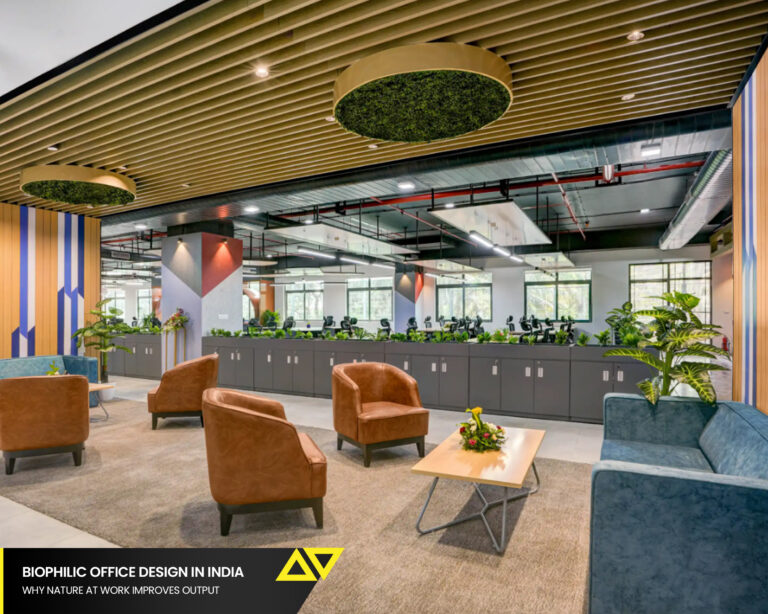
Biophilic design has shifted from a visual trend to an evidence-based strategy. Research from the Human Spaces Global Study, conducted by the University of Exeter and published by Interface, found that workers in offices with natural elements reported a 15% higher well-being score and a 6% higher productivity than those in spaces without them. In IT offices built in 2025 and 2026, biophilic design shows up as living plant walls on reception and key feature walls, natural material palettes, maximised natural light through strategic glazing and light wells, and timber and stone finishes in breakout and lounge areas.
Source: Human Spaces: The Global Impact of Biophilic Design in the Workplace, University of Exeter
Brand integration has become intentional rather than incidental. The best IT offices in India in 2026 are designed so that the spatial language, material palette, colour decisions, and programmatic layout all communicate something specific about the company. For a payments infrastructure company, that might mean precision and restraint. For a consumer technology firm, energy and openness. For a global cloud provider, scale and technical authority. This is brand identity used to drive design decisions from the brief stage, not decoration applied to a generic fit-out.
What the IT Office Design Brief Looks Like City by City
Bengaluru:
The brief here is dominated by engineering culture. Deep-focus quiet zones, war rooms for product sprints, and high-density but quality workstation areas are standard. Green certification is increasingly a baseline requirement, with LEED Platinum and WELL now specified at the brief stage by large technology and GCC occupiers.
Hyderabad:
The fastest-growing IT and GCC market. The brief typically involves larger floor plates and a more diverse mix of functions, reflecting Hyderabad’s industry mix across technology, BFSI, healthcare, and new media. Companies opening their first India GCC often choose Hyderabad, which means the brief is frequently for a space that needs to establish company culture in a new market while being operationally ready from day one.
Delhi-NCR:
Home to product development hubs for global platforms, data engineering, and digital operations. The brief here often involves prestige, client-facing spaces, and design that communicates leadership credibility alongside technical depth.
Chennai:
Chennai saw a 93% year-on-year surge in leasing in Q1 2025, driven largely by technology firms. The city’s mix of IT, automotive technology, engineering, and global operations means the IT office brief in Chennai spans a wider range of functions than in Bengaluru, where the focus is more on engineering.
Source: Colliers India Office Market Q2 2025
Pune and Mumbai:
Pune’s strengths lie in engineering, automotive technology, and BFSI. Mumbai’s technology presence is concentrated in financial technology and analytics, where the brief is more formal and the design language more restrained than at the engineering campuses of Bengaluru or Hyderabad.
The Sustainability Requirement
In Q3 2025, over 70% of newly completed office space was green-certified, and about 73% of all leasing activity took place in green-certified assets. By Q4 2025, green-certified assets represented 93% of newly completed space. Technology companies, many of which have global carbon-neutrality commitments, are increasingly specifying green certification at the interior fit-out level, not just at the building level.
India ranks among the top three countries globally for LEED certifications. For IT offices, the most relevant certifications at the fit-out level are LEED Interior Design and Construction, WELL Building Standard, and IGBC Green Interiors. The best-planned IT office briefs specify the target certification before design begins, because certification requirements shape material selection, MEP specifications, and spatial planning from the outset. Nearly 85% of GCCs in India are actively pursuing carbon neutrality targets for 2030, making green certification a standard brief requirement rather than a differentiator.
Source: USGBC Top 10 Countries for LEED 2024; JLL India: India’s GCCs Are Raising the Bar for Sustainable, Human-Centric Offices
The Multi-City IT Office: A Growing Complexity
Very few large technology companies in India operate from a single city. Bengaluru as the engineering hub, Hyderabad for analytics or BFSI functions, Pune for automotive technology, Chennai for manufacturing-adjacent engineering: the multi-city footprint is the norm for any technology company at meaningful scale.
Maintaining a consistent design language and specification standard across four cities simultaneously requires more than a good set of drawings. It requires procurement infrastructure that works across vendor ecosystems that differ considerably by market, project management that can run multiple sites without sacrificing quality at any, and technology that gives the client real-time visibility into progress at each location.
A workstation in Bengaluru and a workstation in Pune arriving to the same specification sounds simple. In practice, it requires centralised procurement, consistent vendor quality standards, and a delivery team that treats consistency as a design goal in itself rather than a logistical detail.
What Flipspaces Brings to IT Office Projects
Flipspaces has designed and built IT and technology office interiors across Bengaluru, Mumbai, Hyderabad, Chennai, and Delhi-NCR, including multi-city rollouts for the same organisation delivered simultaneously across locations.
The IT office brief demands a design-build partner who understands the specific requirements of technology environments: developer-first acoustic design, sensor-driven utilisation infrastructure, green certification from the brief stage, and the consistency challenge of multi-city delivery. Our technology platform is built around these outcomes.
VIZWALK, our 3D walkthrough platform, lets technology teams and global stakeholders experience a space before civil work begins. Changes are made when they cost very little, not after construction has started. VIZCART, our global product supply chain with over 200,000 products, ensures consistent procurement across geographies, so that a workstation in Bengaluru and one in Pune arrive with the same specifications. VIZCLIENT gives clients real-time visibility into project progress, so decisions are made based on data rather than status calls.
The result is an IT office that is not just designed well. It is an intelligent, future-ready environment built to perform: one that supports the specific work patterns of engineering teams, meets the ESG commitments of the parent organisation, and holds its quality across every city where it is delivered.
If you are planning an IT office or technology campus in India and want to discuss the brief, get in touch with the Flipspaces team.
A Technology Office That Performs
Technology firms are India’s largest and most consistent office occupiers. They drive the design conversation, set the quality bar, and have the most to gain from getting their workspace right. In a market where engineering talent is fiercely competed for, the office has become one of the clearest signals a company sends about who it is and what it values.
The IT office brief in 2026 is more specific, more demanding, and more consequential than it has ever been. Getting it right, from acoustic design and smart technology infrastructure to green certification, wellness, and multi-city consistency, requires a design-build partner who understands what technology companies actually need.
If you are planning an IT office in India and want to talk through the brief, get in touch with the Flipspaces team.
Frequently Asked Questions