The most important work a GCC will do in the next five years may not exist on its organisational chart today. New capabilities will emerge. Teams will take on global mandates. AI will reshape workflows. Functions will move closer to decision-making. The boundaries between technology, product, research and business will continue to blur.
The spaces have to be designed with this horizon in mind.
This is particularly relevant in India, where more than 2,100 GCCs now employ around 2.36 million professionals and generate nearly $100 billion in revenue. The nature of this ecosystem is changing alongside its scale. Zinnov-Nasscom’s 2026 GCC Landscape found that 96% of GCCs established after FY2021 entered with a product or portfolio mandate, while 49% were AI-first from inception.
These numbers point to a broader change in the brief. The GCC enterprise is no longer simply where a growing workforce is accommodated. It is becoming part of the environment in which new capabilities are developed, teams are assembled and organisations adapt.
That calls for a different approach to enterprise design.
The right environment enables talent to perform at their best
The modern knowledge enterprise has to accommodate a greater range of human behaviour than the conventional office was designed for.
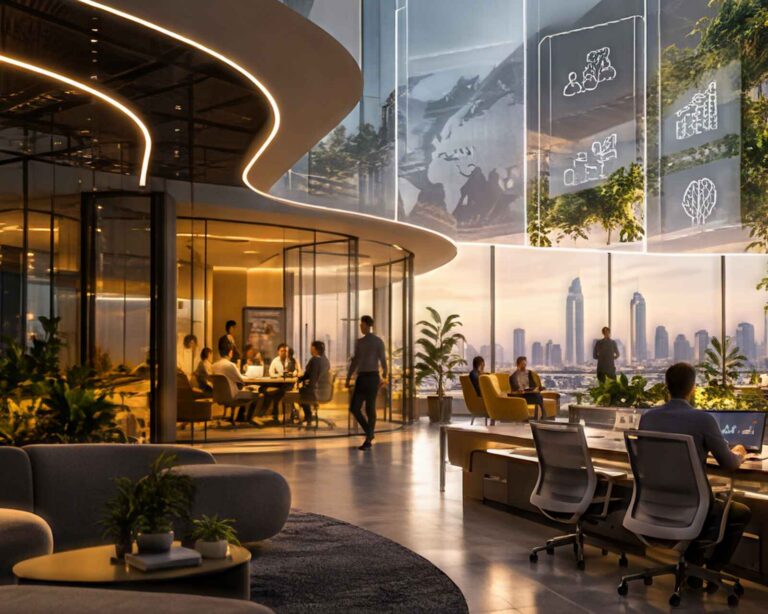
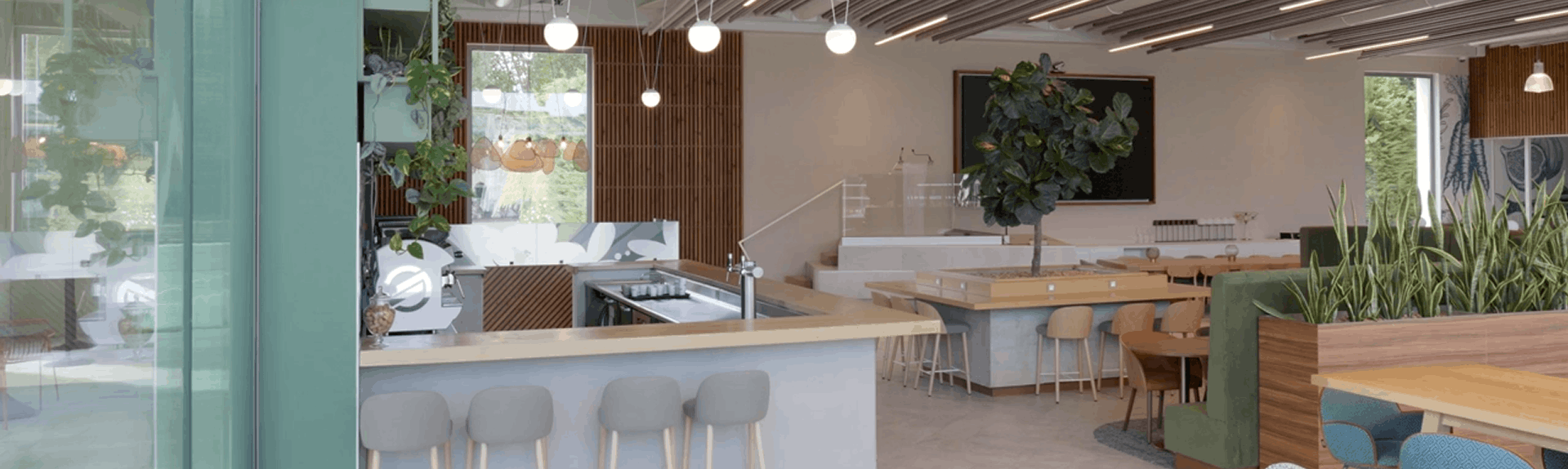
A single day can move between deep individual work, collaboration, mentoring, virtual meetings, problem-solving and informal interaction. The enterprise has to support these shifts without forcing every activity into the same spatial language.
JLL’s India GCC research found that 47% of the working day is spent on individual focus work, even as 60% of employees prefer hospitality-style environments. Rather than presenting these as competing requirements, the finding points towards a more nuanced enterprise: one that can provide energy and interaction without compromising concentration.
This makes choice an important part of the design brief.
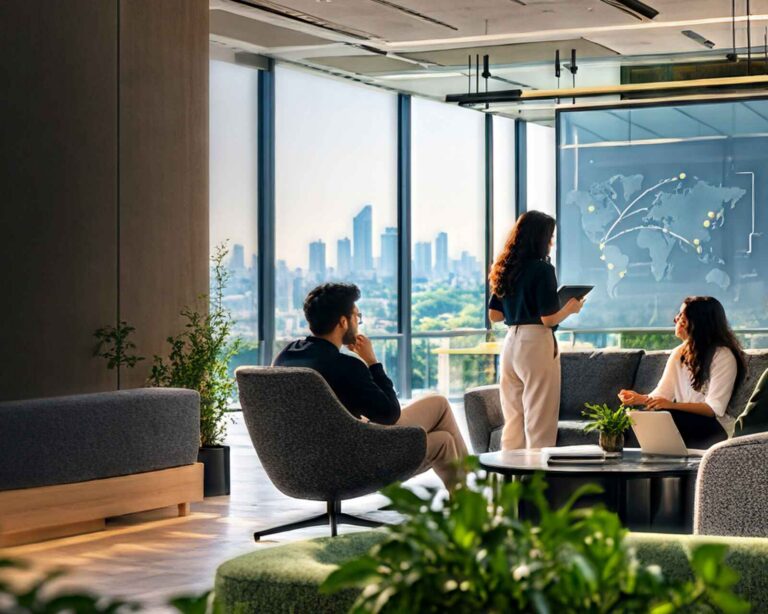
A team working through a complex problem may need a space that can change with the conversation. An individual working on a high-concentration task may need acoustic separation and visual privacy. A distributed team may need technology-enabled environments that make remote colleagues feel present rather than peripheral.
The answer is not simply more spaces. It is better relationships between spaces, so that movement between focus, collaboration and connection feels natural.
For GCCs competing for specialised talent, this also makes the enterprise part of the employee proposition. The environment communicates how an organisation works, what it values and the kind of experience it wants to create.
Technology should be part of the enterprise’s DNA
The influence of technology on the enterprise is often measured through what can be seen: screens, sensors, meeting systems and connected devices.
The more consequential changes are often less visible.
AI is altering workflows, team structures and the nature of knowledge work itself. As that happens, the physical infrastructure supporting work needs to become more responsive. Connectivity, power, acoustics, data infrastructure and meeting environments need to accommodate technologies that will continue to evolve.
That same principle should apply to the way the enterprise is designed and delivered.
Technology can connect the decisions that traditionally sit apart: design, cost, sourcing, material availability, timelines and execution. A design can be evaluated not only for how it looks, but for whether it can be procured, budgeted and built within the realities of the project.
For GCCs operating across locations and at considerable speed, this creates an important advantage. Greater visibility earlier in the process allows the enterprise to be shaped around what is possible, rather than discovering constraints after the design has already been established.
The result is not simply a more technology-enabled enterprise. It is a more intelligent way of creating one.
Transformation needs space to unfold
Transformation is difficult to design because it rarely arrives as a defined spatial requirement.
A GCC may expand from engineering into product development. An analytics function may evolve into a global centre of excellence. An organisation may introduce new AI capabilities that fundamentally change how teams are structured. What begins as a defined mandate can acquire considerably greater strategic responsibility over time.
The enterprise needs enough resilience to accommodate that trajectory.
Adaptability therefore becomes a practical consideration across the environment. Planning systems should allow teams to expand and contract. Furniture and partitions should support changing configurations. Infrastructure should be capable of absorbing new technologies. Spaces should be able to take on different functions as organisational needs evolve.
There is an equally important question around how global enterprise strategies are translated locally.
Consistency can establish a common identity, but identical environments do not necessarily create consistent experiences. The way people collaborate, use technology, socialise and engage with their enterprise varies across markets. Local context needs to inform the design without diluting the larger organisational identity.
The result is the space that is recognisably part of a global enterprise, while still feeling designed for the people and culture within it.
Designing for the horizon
Talent, technology and transformation are not separate enterprise considerations. They continuously influence one another.
The way people work determines the spaces they need. Technology changes those patterns of work. Organisational transformation changes both. The space sits at the centre of this relationship, translating an organisation’s ambitions into an environment that people can actually experience.
That makes the process of creating the enterprise as important as the finished space.
At Flipspaces, we bring design, sourcing, technology and execution into one connected process, giving project teams greater visibility into the decisions that shape cost, procurement, timelines, site conditions and the final environment. The objective is to create spaces that are grounded in today’s realities while remaining capable of responding to tomorrow’s requirements.
Because the strongest GCC enterprises will not be defined by how well they represent the organisation at a particular moment.
They will be defined by how much possibility they leave open for what comes after it.
Frequently Asked Questions