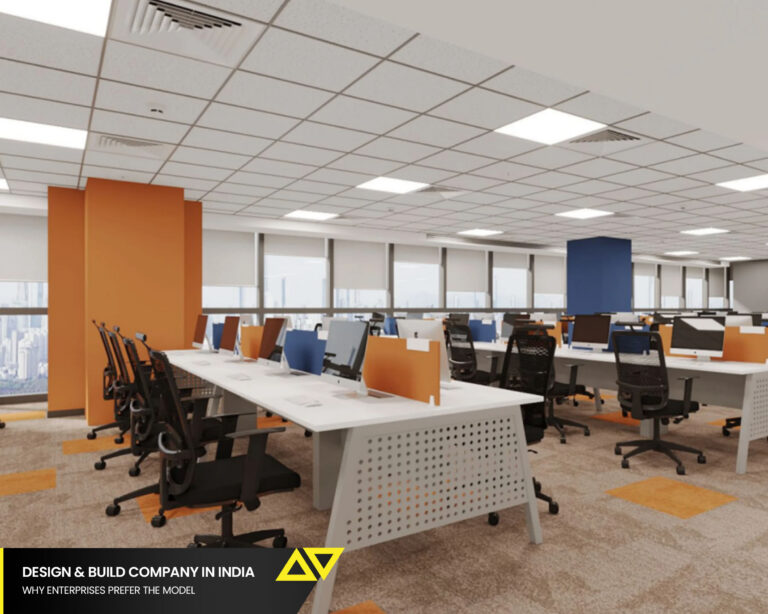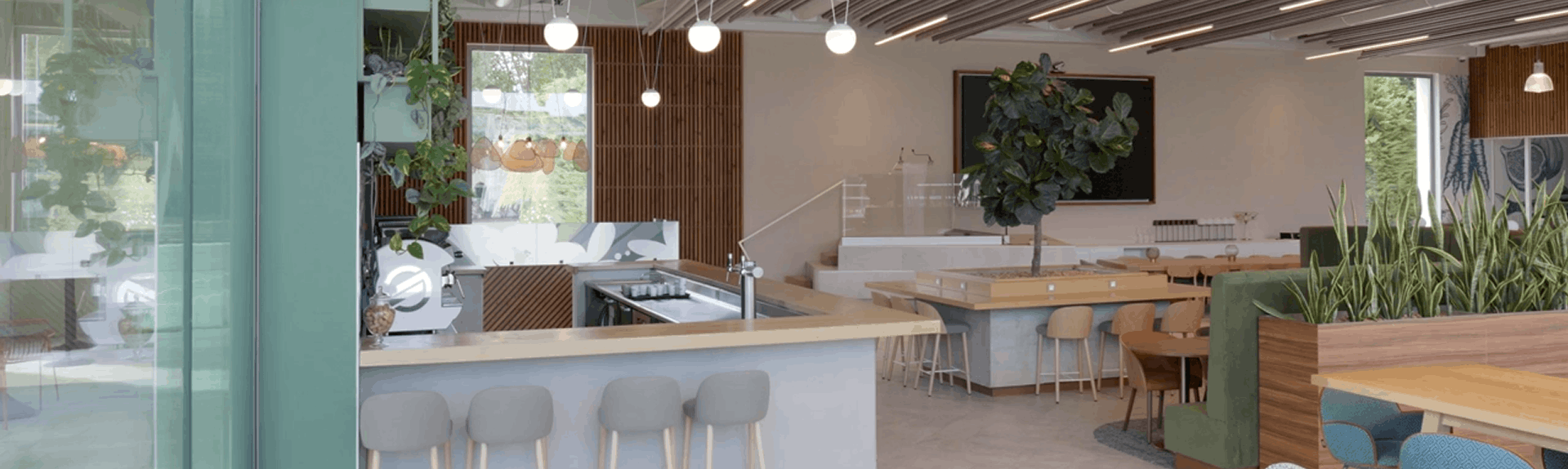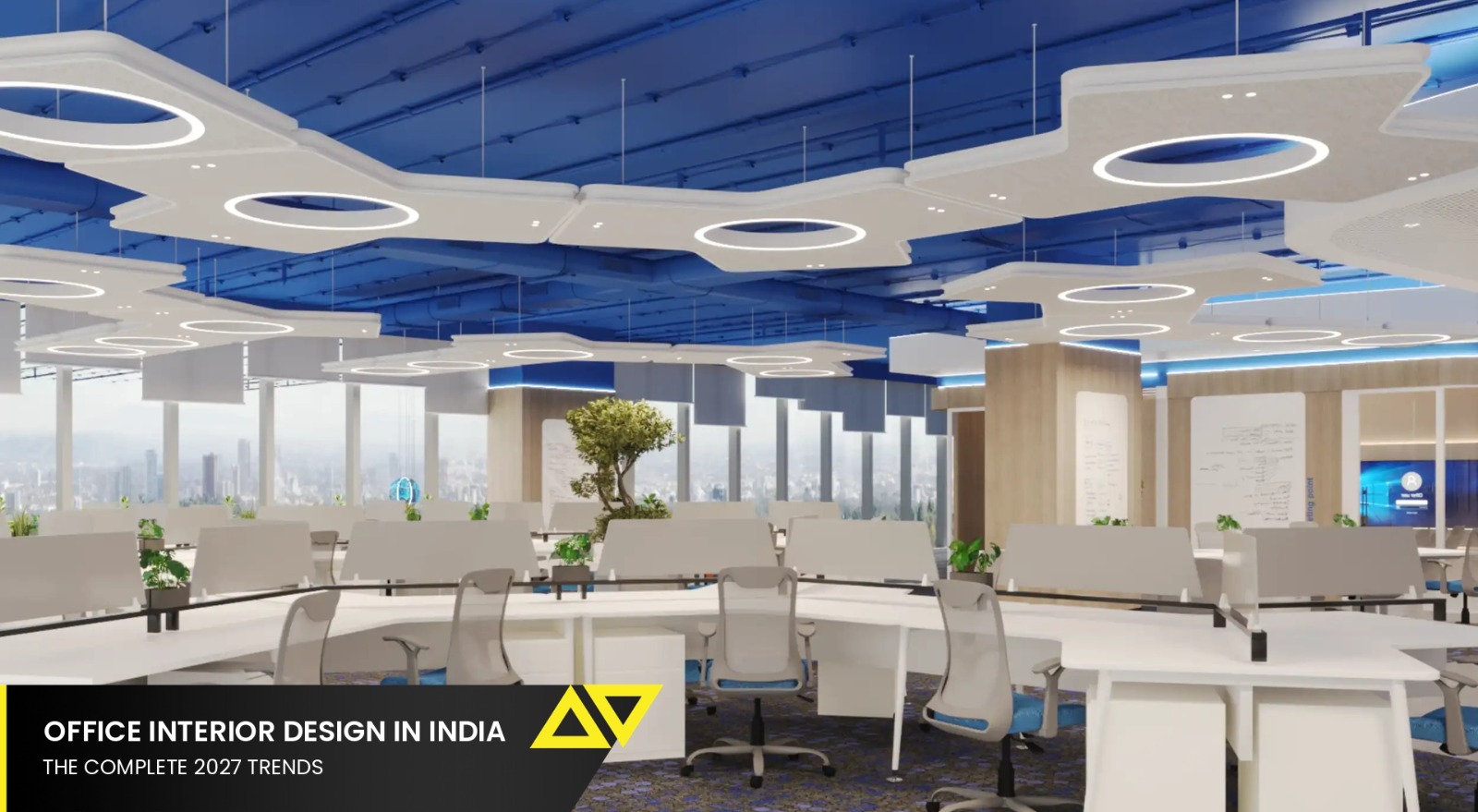
The latest trends in office interior design in India point in one direction for 2027: better offices that have to earn the commute. Green certification is becoming the baseline, layouts are being planned around the days people actually come in, flexible space is taking a larger share of demand, and technology is moving out of gadgets and into the building itself.
Picture two offices in the same Bengaluru tech park on a Wednesday morning. The first was fitted out in 2019: rows of fixed desks, two meeting rooms, a pantry in the corner, and a floor that is half empty. The second opened this year. It has fewer desks, far more rooms, a café people choose to work from, and sensors quietly recording how each zone is used. Both cost money to run. Only one is doing the job an office in India now has to do.
What follows are the six shifts with real data behind them, and what each one means when you are planning a fit-out.
Key Takeaways
|
What Are the Latest Trends in Office Interior Design?
Many lists of office interior design trends are really lists of finishes: this year’s colour, this year’s texture. Those change every season and matter less than they seem. The trends shaping workplace design in India for 2027 run deeper. They are about what a building is certified to do, how often people turn up, who else is sharing the floor, and how much the space knows about its own use.
Office Interior Design Trends Shaping 2027
Green Certification Becomes the Baseline
Certification used to be a differentiator. It is quickly becoming the entry ticket. CBRE reported that 76% of newly completed office space in Q2 2026 was green-certified, with 73% of leasing concentrated in certified assets. The quarter before, the figures were 72% and 79%. Equirus, counting the half year rather than the quarter, reaches the same place at 76% of completions and 73% of leasing (source: CBRE). CBRE’s commentary describes occupiers increasingly treating LEED and IGBC certification as the minimum standard. For a fit-out, that means material, lighting and ventilation choices have to hold up to the building’s rating rather than quietly undermine it.
Planning Around the Days People Come In
JLL’s Future of Work survey found 90% of Indian organisations require employees in the office at least three days a week, against 85% globally (source: JLL). The design consequence is subtle. Floors are busiest on the same two or three days, so meeting rooms, focus space and pantries run out at exactly the moments that count. Offices in India are being planned for the peak day rather than the average one, which we look at in more depth in hybrid office design in India.
Fewer Desks, More Places to Work
In many offices the desk-to-room ratio is shifting. People come in to collaborate and to concentrate, and a floor of open desks alone rarely supports both. The office interior trends that follow from this are practical ones: more bookable enclosed rooms, phone booths near where calls happen, and quiet zones separated from social ones. Noise is often one of the first complaints on a busier floor, which is why acoustic design for Indian offices has moved up the brief.
Flexible Space Moves Into the Corporate Portfolio
Flex operators led leasing in CBRE’s count for the second quarter of 2026, at 27% of the total, ahead of technology at 21% and BFSI at 13% (source: JLL). Looking ahead, Colliers projects flex leasing of 15 to 18 million sq ft (1,393,545.6 to 1,672,254.7 sq m) in 2026, around 20 to 25% of the total (source: Colliers). These are projections rather than outcomes, but the direction is clear: many Indian companies now run a core office alongside managed or flexible floors, and the two need to feel like the same organisation.
Wellness You Can Measure
Wellness is moving from a mood-board word to something with a certificate attached. The International WELL Building Institute reports over 895 assets enrolled in WELL across India, with 140 WELL projects under way (source: IWBI). In practice that puts air quality, daylight, water and acoustic comfort into the specification, which overlaps closely with the evidence behind biophilic office design.
Technology Built In, and Space That Can Change
The same JLL survey found 94% of Indian organisations expect AI to change how their workforce operates. For an office interior, the practical version is occupancy sensors, room booking, daylight-linked lighting and a network planned for them from day one, which is usually far cheaper than retrofitting, as we set out in integrating smart office technology during a fit-out. Adaptability is the other half of this, and it is driven by something firmer than a survey. India’s Construction and Demolition Waste Rules took effect on 1 April 2026 and cover remodelling and renovation as well as new build, with escalating recycling obligations for larger projects. Demountable partitions and modular furniture let a floor follow the organisation as it restructures, and they now also reduce what has to be reported when it does. That is the argument behind modular and future-ready office design.
Which Office Interior Trends Matter Most for Indian Workplaces?
Not every trend deserves budget in every office. This is how each one translates into a fit-out decision.
| Trend | What is driving it | What it means for your fit-out |
|---|---|---|
| Green certification | Certified buildings now dominate new supply and leasing | Specify materials, lighting and ventilation that support the rating |
| Peak-day planning | Mandated office days cluster people on the same days | Size rooms and amenities for the busiest day |
| More settings, fewer desks | People come in to collaborate or concentrate | Bookable rooms, booths and quiet zones |
| Measurable wellness | WELL enrolment is growing across India | Air, light and acoustic comfort written into the specification |
| Built-in technology | Organisations expect AI to reshape operations | Sensors and network capacity planned at design stage |
Is Your Office Ready for 2027?
Answer these honestly about your current office. They take a minute and tell you where to look first.
- On your busiest day, can people find a meeting room without booking days ahead?
- Does someone on your team know whether your building is green-certified, and to what level?
- Could you move a team without calling in a contractor to rebuild walls?
- Do you know which zones sit empty most of the week, or are you guessing?
- Would your people choose the office over home for focused work?
If two or more answers were no, the office is working against the way your organisation now operates, and the gap is usually cheaper to close at the next fit-out than it looks.
Planning an office for 2027?
|
Frequently Asked Questions