In Brief: The hardest part of a multi-city office rollout is not building several good offices. It is deciding what has to stay identical across every city and what should be free to change, and then holding that line while each location pulls in its own direction. Get the judgment right and offices in five different cities can still feel like one company rather than five loosely related ones. Get it wrong, and the brand quietly splinters into a slightly different version of itself in each place. This guide looks at how enterprises planning a multi-city office rollout in India make that call, and at the multi-city office interior solutions that turn the decision into something you can actually deliver.
What a Multi-City Office Rollout Involves
A multi-city office rollout is a programme in which one organisation builds offices in two or more cities to a single standard, usually within the same broad time frame. The difficulty is rarely any one office; it is the coordination between them.
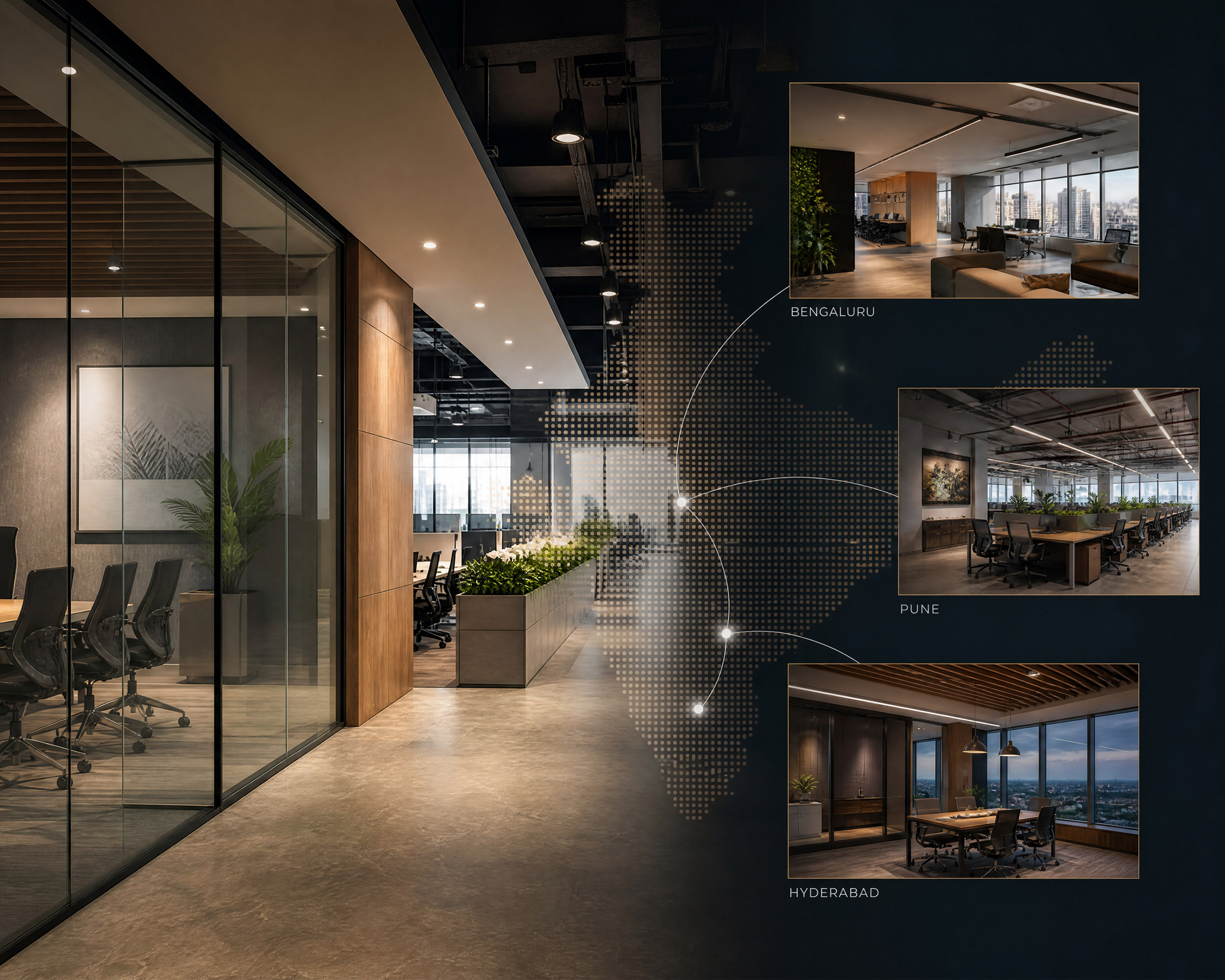
The same design, quality, and brand have to arrive in Bengaluru, Pune, and Hyderabad through vendor networks, building stock, and site teams that look different in every city, so the real job is keeping one intent steady while everything underneath it changes. That is why multi-city office interior solutions are less about design talent in a single location and more about the system that carries a standard from one city to the next.
Why Multi-City Has Become the Norm for Indian Enterprises
Very few large organisations in India still run from a single building. The more common shape now is a hub with a set of spokes, a headquarters in one city, an engineering or analytics centre in another, and a newer satellite somewhere with fresh talent and a lower cost base. Nasscom and Zinnov reported in July 2026 that India hosts 2,117 global capability centres across 3,728 units, which works out to close to two sites for every centre.
Source: Nasscom and Zinnov, GCC Value Orbit, July 2026
What matters more than the count is what it does to the brief. Once a company is planning office interiors for multi-city expansion, the parent almost always holds every location to one global workplace standard, wherever it happens to sit. A satellite in a smaller city is expected to match the specification of the flagship in Bengaluru, and that single expectation is what turns a handful of separate fit-outs into a rollout. It is also why a programme like this cannot be run as a loose collection of local projects that happen to share a logo, because the standard has to travel even when the city changes.
Consistency Is Not the Same as Sameness
When a company is setting up offices across multiple cities, it is tempting to make every location look exactly the same. But that approach can quickly become expensive, impractical and, frankly, a little dull. Not every building will have the same floor plate or services, and not every team will use the space in the same way. Trying to force one office layout into every location can create more problems than it solves.
The better approach is to decide what really needs to stay consistent. The brand identity, the overall design language, the quality of the materials and finishes, and the experience of entering the office should feel familiar wherever an employee or visitor walks in. The workstations, meeting rooms and other frequently used elements should also follow a common standard. These are the details that help different offices feel like part of the same organisation.
There is more room to adapt when it comes to the building and the city itself. Floor plates, services and local approvals will vary from one location to another. An engineering centre may need a very different layout from a sales office. Even small touches, such as local materials, artwork or references to the city, can give a space its own identity without taking it away from the larger brand.
The key is to decide these boundaries before the rollout begins. If every site team is left to make those decisions independently, small changes can start adding up. By the time the fourth or fifth office is complete, it may look noticeably different from the first. A clear design standard gives each location enough flexibility to work for its own context while keeping the overall workplace experience consistent.
How a Multi-City Rollout Actually Holds Together
Deciding the standard is only half the work. The other half is having a way to carry it into several cities at once without letting it erode along the way, and in practice a few connected disciplines do most of that work.
It begins with a single master specification that every city builds from, rather than a separate spec per site that each team quietly adapts until the offices drift apart. Local adjustments still happen, but they happen as controlled exceptions to that one master, not as a fresh start in each city. Alongside it, the design needs to be settled before any city begins on site, because a late change that would be merely painful on one office multiplies across a rollout, forcing the same rework into every location and unpicking the cities that were already ahead. Resolving the design thoroughly and early is what protects the timeline for the whole programme.
Quality also needs a clear reference point. Building and signing off one reference space early in the programme gives every other city something concrete to work towards. Site teams can see exactly what the finished space is expected to look and feel like, rather than relying on drawings or individual interpretations.
The same approach works for procurement. Elements that need to remain consistent can be specified once and sourced centrally, so the same workstation or meeting room setup can be delivered to the same standard in Bengaluru, Pune and other locations. Planning these purchases in advance also helps manage long-lead items and ensures materials reach each site when they are needed.
A shared view of all the locations then keeps the programme on track. Teams can see progress, quality, and potential issues across cities in real time, making it easier to address problems early rather than discovering them during handover. None of this is particularly complicated. It is about putting the right processes in place before a multi-city rollout gets too large to manage informally.
Why One Partner Beats a Local Firm in Every City
Faced with several cities, the natural instinct is to appoint a strong local firm in each one, on the reasoning that they know their own market best. It feels like the safe choice, and it quietly surrenders the very thing a rollout exists to protect. Five firms produce five interpretations of the standard, five procurement chains and five ideas of what good looks like, and the client is left trying to reconcile all of them. Bringing the whole programme under a single partner offering enterprise design and build services turns that around. The standard gets set once and delivered everywhere, procurement runs through one catalogue, quality answers to one benchmark, and the client deals with one accountable team instead of managing five separate relationships. Local market knowledge still matters a great deal, but it is far easier to bring that knowledge into one system than to build a single standard out of five different firms.
How Flipspaces Approaches Multi-City Rollouts
At Flipspaces, a rollout is treated as one programme rather than a series of separate projects, and that shapes how the work is run. Our technology platform, VIZWORLD, is built around exactly this challenge. Its design visualisation lets stakeholders in every location walk through each space in full before construction begins, so alignment happens early, and the design can be frozen with confidence.
Our global product supply chain of more than 200,000 products holds specification and quality steady from one city to the next, so what gets built in Bengaluru matches what gets built in Pune. And our live project tracking gives the client and every site team a single view of progress and quality across all locations at once.
Taken together, these multi-city office interior solutions are what let a rollout move quickly without letting quality slip, and they run across offices, hospitals, retail, and education, in India and abroad.
The result is meant to be simple to recognise. Every office reads as the same company, built to the same standard, while still feeling like it belongs in its own city. You decide what your organisation should never compromise on, and the job of a partner handling office interiors for enterprise companies is to hold that line in every location it lives in.
One Company, Many Cities
A multi-city office rollout is ultimately a test of whether a company can grow across the country without losing itself. The ones that succeed are not the ones that made every office identical; they are the ones that knew exactly what had to stay the same and had the discipline to hold it, while letting each city keep enough of its own character to feel real. Decide that line well, build to it consistently, and a company can open in five cities and be recognised in all of them. If you are planning a multi-city office rollout in India and want it to stay true to itself from the first city to the last, get in touch with the Flipspaces team.
Frequently Asked Questions