Did you know how much the world economy lost due to low levels of employee engagement in 2025? According to the State of the Global Workplace 2026 report by Gallup, low engagement resulted in productivity losses of approximately $10 trillion, or 9% of global GDP.
The situation in India is equally concerning. Employee engagement in the country hit a four-year low in 2025, costing the Indian economy an estimated $351 billion in lost productivity. South Asia also recorded the steepest decline in employee engagement of any region worldwide.
Now, to be fair, low employee engagement is caused by multiple factors, not just one. However, the connection between office interior design and employee engagement is something that often gets overlooked. Office interiors can have a huge impact on the way employees feel and interact, thereby making them more (or less) engaged at work. When employees find their workplace poorly designed or uninspiring, their productivity takes a hit and your business suffers. But that’s not all. In addition to loss of productivity, a poorly designed office can hold your business back in many other ways. However, the negative impact doesn’t happen out of nowhere. There are always signs before things boil over. Here are 7 signs that it may be time for you to hire an office interior design company.
-
When Productivity Starts to Decline
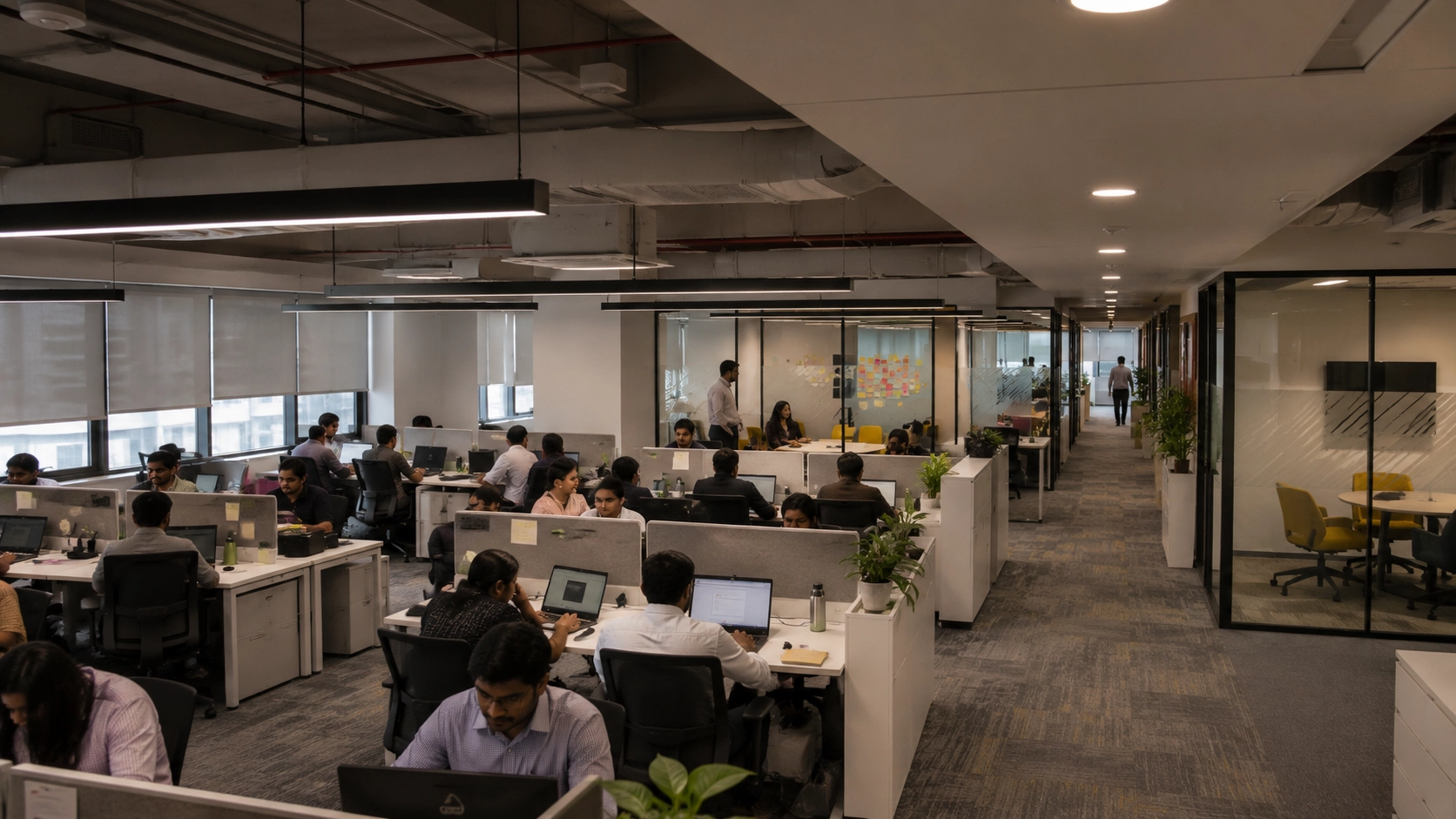
If employee productivity is constantly at a low, it is important to dig deep and find out what is causing it. The answer may, at least in part, trace back to one problem: poor office interior design. An employee who is required to work on a task that requires deep focus might have trouble with high background noise. Another one may be facing aches and pains due to wrong desk heights, uncomfortable chairs or lack of natural light. A third one may simply feel uninspired due to a generic and bland design.
Poor ventilation and unsuitable indoor temperatures can also affect cognitive performance and productivity. A Harvard study published in Environmental Health Perspectives recorded cognitive scores 61% higher in well-ventilated, low-pollutant conditions and 101% higher with enhanced ventilation. Lawrence Berkeley National Laboratory found office task performance peaks near 22°C and drops to 91.1% of maximum at 30°C.
More often than not, if productivity levels are consistently low, it’s a clear enough sign that your office design is working against employees rather than helping them.
-
When Collaboration Becomes Difficult
Does your office design encourage spontaneous conversations? Does the layout ensure easy access to coworkers? Is it easy for your employees to shift between heads-down individual work and group meetings? If the answer to these questions is no, your office has a collaboration problem.
An open floor plan is great. But it doesn’t automatically make a workspace more collaborative. If there are not enough spaces for brainstorming and idea generation, spontaneous interactions are limited or huddle and collaboration zones remain empty despite being available, it may be time to consult workplace interior designers to create a layout that supports collaboration.
-
When Your Office No Longer Reflects Your Brand
Your brand tells a story. Your office tells a story, too. And if the two stories don’t match, there might be an issue with the way your business is perceived. If a brand thrives on creativity, the office should ideally have expressive colours and materials that reflect the creative spirit of the brand. An accounting or a law firm, on the other hand, would do better with a more refined setting. Also, businesses evolve over time, and their office spaces need to evolve with them.
An office designed for a thirty-person startup rarely says the right thing about a company that now employs three hundred and sells to enterprise clients. If your business has changed what it does or who it sells to, and the office still reflects the old version, it may be time to rethink your corporate interior design.
-
When First Impressions Fall Short
Be it a client who walks in for a business meeting, a candidate who comes for an interview or any other visitor, first impressions matter. If you find yourself apologising for bland meeting rooms or making last-minute arrangements for a big client visit, it’s high time you redesigned your office space. Your office space can subtly influence whether a prospective client decides to do business with your company or a candidate chooses to join your team. That second one matters more in India than in most markets: in the Human Spaces survey of 7,600 office workers, 67% of Indian respondents said office design would affect their decision about where to work, against 33% globally.
-
When Office Space Is Poorly Utilised
Office space is costly. It must be utilised effectively. Does your office have large boardrooms that are used only occasionally? Are there too many awkward corners? Is there plenty of vertical space that hasn’t been utilised properly, while the rest of the office looks cluttered? If yes, it’s a sign that your office needs renovation. For every square footage that goes unused, you’re paying for something you’re not using. Poor office space planning can also spike up your energy bills. You may end up spending more on utility costs as unused spaces may still need lighting, cleaning and air-conditioning. Most companies over-build large meeting rooms and under-build the two-to-four-person spaces people actually use all day. Count your real meetings before you count your boardrooms.
-
When Employee Complaints Keep Growing
If your employees are complaining more and more about constant noise, meeting rooms that are always booked, a lack of quiet zones for important calls, poor ventilation, and any other workplace issue, it’s a sign that your business needs a modern corporate office design. Noise and privacy are worth taking seriously rather than treating as grumbling. An analysis of 62,000 responses from more than 600 office buildings found sound privacy to be the worst-performing issue in the entire dataset, and occupants of open-plan offices with low or no partitions were almost twice as likely to be dissatisfied as those in enclosed ones.
While there may be a few chronic complainers in every workplace, it’s important not to ignore genuine complaints. If these issues persist, they can have a very negative impact on employee morale and your business may find it difficult to retain them.
-
When the Office Cannot Absorb Growth
This is the sign that creeps up quietly. Headcount rises, a team restructures, a new function is added, and every change means furniture being shuffled into corridors, a meeting room being turned into a workspace, or a team being split across two floors because nothing else fits.
If adding fifteen people means calling a contractor, the floor was built for a company you no longer are. Offices change shape far more often than leases end, which is why demountable partitions, modular furniture and services laid out with spare capacity are worth planning for from the start. The alternative is paying to rebuild the same floor every time the organisation evolves.
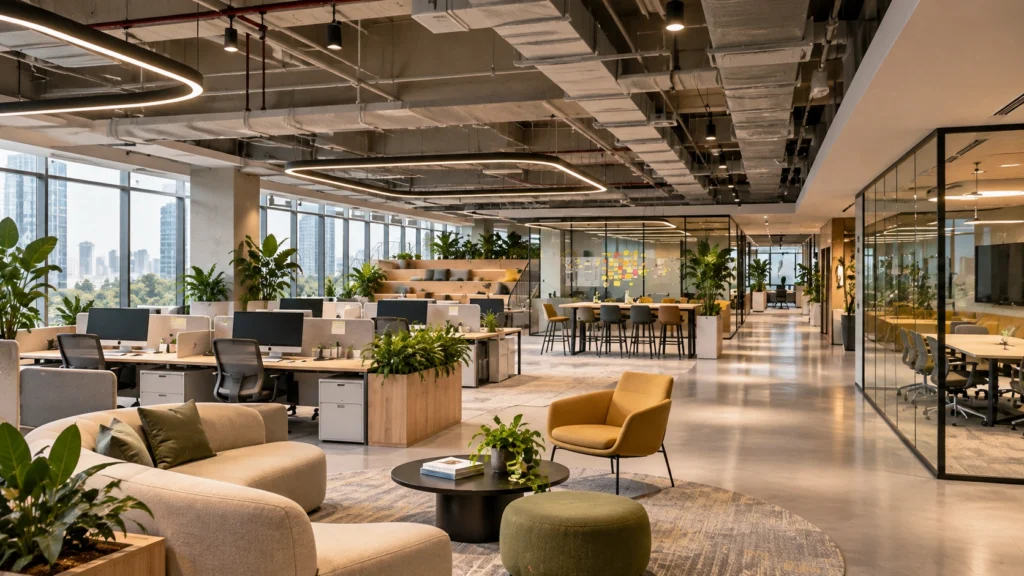
Ultimately, an office space is much more than just a place to work. Your office interior design should reflect the evolving needs of your business and your employees. The riskiest thing a business can do is ignore the obvious signs that its office space needs a redesign. An outdated office has a negative impact on everything, from productivity and energy efficiency to brand image.
Recognising the signs is the easy part. Deciding what to do about them is harder, and the right answer is not always a redesign: sometimes the layout needs reworking, sometimes the building itself is the constraint. We set out how to choose between refurbishing, reconfiguring and relocating in our guide to office renovation in India.
Seeing more than two of these signs in your own office?
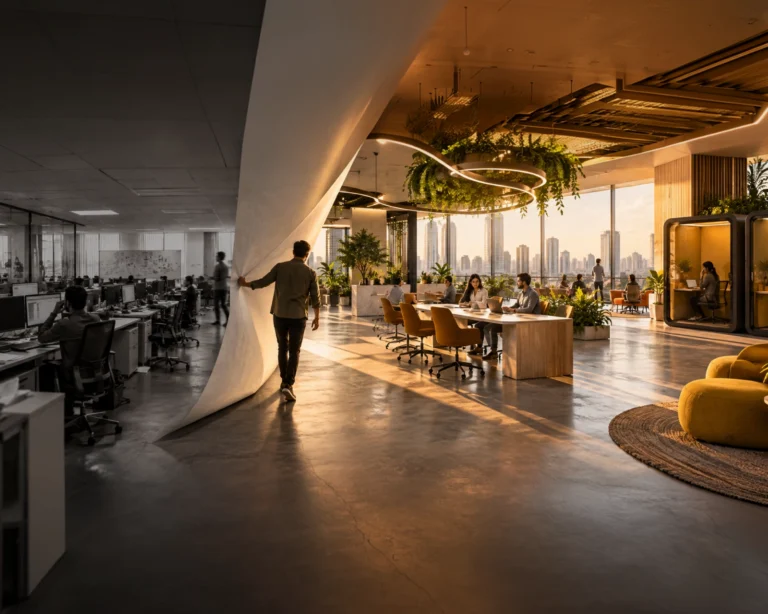
Flipspaces designs and builds workspaces end to end, from the first brief to handover, and shows you the finished office in 3D through VIZWALK before anything is built. Talk to our team about your floor, your headcount and what isn’t working.
Frequently Asked Questions