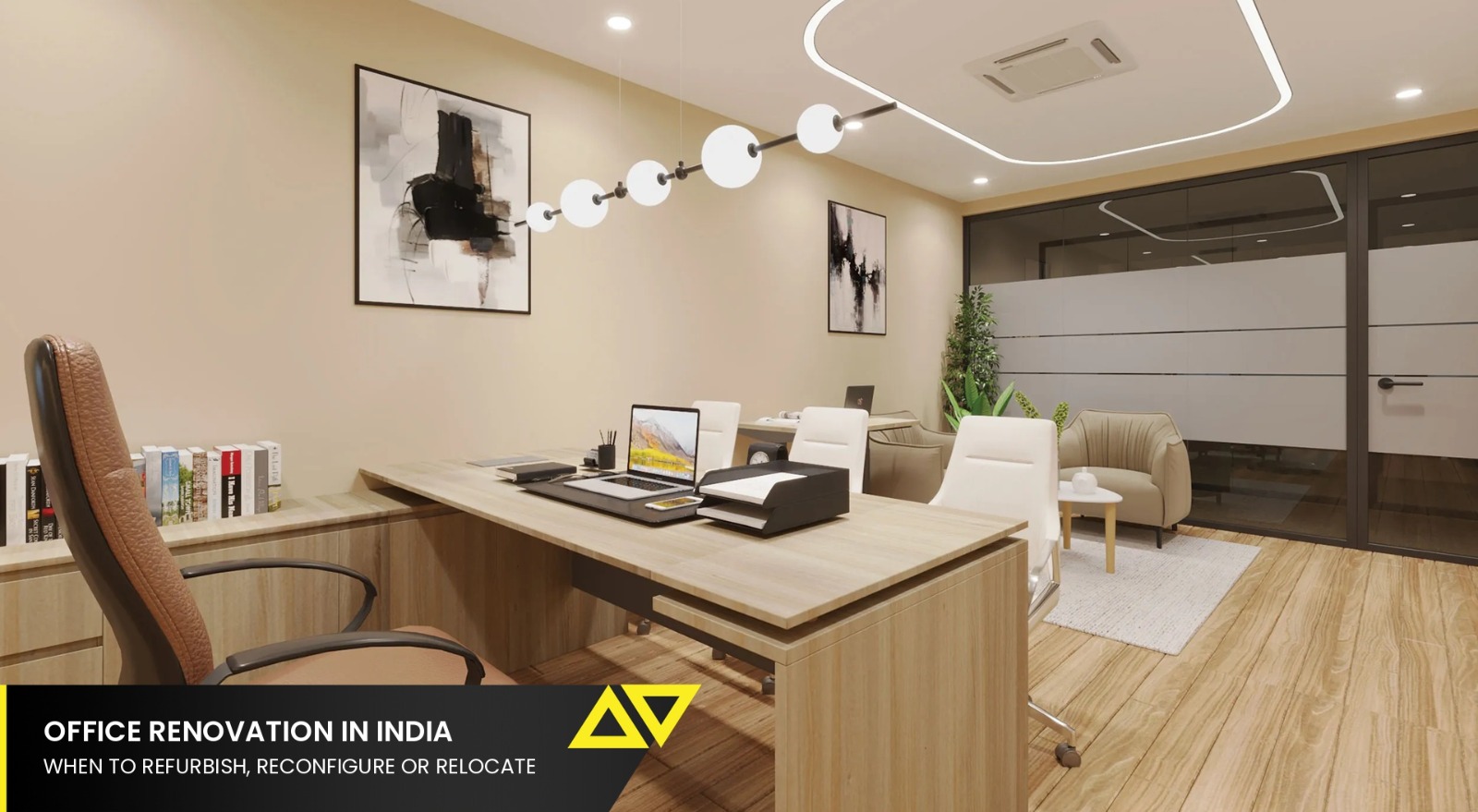
Office renovation in India usually comes down to one of three choices: refurbish the space you already have, reconfigure how it is laid out, or relocate to a new building. The right answer depends less on how tired the office looks than on four things: how much of the lease is left, whether the building can support what you need, how the organisation is changing, and what each option really costs once disruption is counted.
Picture a 400-person team in Pune with 22 months left on its lease. The carpet is worn, the meeting rooms are booked solid by 10am, and the leadership team is split three ways. Finance wants new chairs and a fresh coat of paint. HR wants a new building closer to the metro. The head of operations suspects the real problem is the layout. All three are partly right, which is exactly why the decision needs a method rather than a vote.
Key Takeaways
|
Should You Refurbish, Reconfigure or Relocate?
The three options solve different problems, and a common mistake is picking one before naming the problem. This is how they compare.
| Option | What it changes | When it fits | Main risk |
|---|---|---|---|
| Refurbish | Finishes, furniture, lighting and flooring | The layout still works; the space simply looks tired | Spending on appearance when the real problem is layout |
| Reconfigure | Layout, room mix, zoning and services within the floor | Working patterns have changed; the building is sound | Underestimating services changes and approvals |
| Relocate | Everything, including the building | The building limits growth, quality or location | Reinstatement, deposits, overlapping rent and downtime |
| The myth
Relocating is the only way to get a genuinely new office. |
What the evidence says
Much of what makes an office feel new, such as room mix, zoning, lighting and acoustics, can change in place through office interior renovation. Relocation adds costs a refit avoids: restoring the old premises to bare shell where the lease requires it, a fresh deposit, and a complete new fit-out, which Cushman & Wakefield benchmarks at INR 5,847 to 6,567 per sq ft (INR 62,936.6 to 70,686.6 per sq m) in 2026. |
How Does Your Lease Shape the Decision?
Lease terms often matter more than design. Lock-in periods in Indian commercial leases commonly run from one to three years, and leaving inside one usually means forfeiting the deposit or paying the remaining lock-in rent (source: Brigade Group). Many leases also require premises to be restored to bare-shell condition at exit, which quietly turns a relocation into two projects: undoing the old office and building the new one.
That second project has a published price. The same Cushman & Wakefield guide puts reinstatement at roughly USD 5 to 15 per sq ft across Indian cities, with Mumbai highest at around USD 7 to 15 and most other markets between USD 5 and 13, depending on how far the space has to be stripped back. On a 30,000 sq ft floor that is a six-figure dollar obligation that sits entirely outside the budget for the new office, and it is the line most often missing when a relocation is first costed.
As a working rule, the less time left on a lease, the harder it is for a heavy refit to pay back, and the more seriously a relocation deserves to be priced. With several years left, reconfiguring in place usually gives more for the money.
What Does Office Renovation Cost in India?
Office renovation cost in India depends as much on scope as on floor area. Cushman & Wakefield’s 2026 guide puts an all-in collaborative fit-out at INR 5,847 to 6,567 per sq ft (INR 62,936.6 to 70,686.6 per sq m) across major Indian cities, or USD 65 to 73 per sq ft (USD 699.7 to 785.8 per sq m), with Mumbai at the top of the range (source: Cushman & Wakefield). That benchmark includes professional fees, furniture, MEP, technology and reinstatement provision.
Our own published ranges for office interiors run from INR 1,400 to INR 4,000 per sq ft (INR 15,069.5 to 43,055.6 per sq m) for most projects, rising to INR 7,500 per sq ft (INR 80,729.3 per sq m) for premium work, as set out in what a turnkey office interior costs in India. The two measure different scopes rather than contradicting each other: a light refurbishment tends to sit well below the benchmark, a full reconfiguration with new services much closer to it.
| USD 65 to 73 | per sq ft (USD 699.7 to 785.8 per sq m) for an all-in office fit-out in India, against USD 215 per sq ft (USD 2,314.2 per sq m) in Tokyo, USD 161 in Sydney and USD 140 per sq ft (USD 1,506.9 per sq m) in Singapore.
Source: Cushman & Wakefield, India Office Fit Out Costs and Market Insights 2026 |
Four things move the number most in a renovation: whether the floor stays occupied, how much existing MEP can be reused, how much demolition the new layout needs, and whether the changes trigger compliance upgrades. Working on an occupied floor tends to cost more per sq ft, because it is phased and often done outside working hours, yet it avoids the cost of moving, which is usually larger.
| 77% | of fit-out contractors in India expect their pricing to rise slightly over the next six months.
Source: Cushman & Wakefield, India Office Fit Out Costs and Market Insights 2026 |
Planning an Office Renovation Without Stopping Work
Much of the office renovation work in India happens around people who still need to work, so the phasing plan belongs in the design rather than being improvised on site. A few principles make the difference.
- Someone needs to survey the existing services before anything is designed, since reusable MEP is where much of the saving in a renovation comes from.
- The end-state design is best locked before work starts, because a change made mid-phase ripples through every zone that follows.
- Each phase works best as a complete zone, so teams move once into finished space rather than twice into half-finished space.
- Noisy and dusty work usually shifts to evenings and weekends, which adds time but keeps the business running.
The same zone-by-zone logic we use on large projects is described in planning a large office interior in 90 days.
Where Your Strip-Out Waste Goes Is Now a Regulated Question
This is new enough that most renovation briefs have not caught up with it, and it applies to this article’s subject more directly than to almost anything else.
The Environment (Construction and Demolition) Waste Management Rules 2025 came into force on 1 April 2026, replacing the 2016 rules and introducing India’s first Extended Producer Responsibility framework for construction. The scope covers construction, demolition, remodelling, renovation and repair. A strip-out is inside it.
Projects at or above 20,000 sq m built-up area are classified as producers, which brings registration on a CPCB portal, a waste management plan filed with the local authority, and recycling targets that escalate from 25% of the previous year’s waste towards 100% by 2028-29. There is a materials requirement too, with minimum use of processed C&D waste phasing in from 2026-27.
Two practical consequences. A reconfiguration that reuses partitions and services generates less regulated waste than one that demolishes and rebuilds, which is a reporting advantage as well as a cost one. And a relocation produces strip-out waste at the old premises and construction waste at the new, so the option that looks cleanest on a mood board is the one that generates the most.
The rules are new, the recycling infrastructure behind them is thin in most cities, and there is acknowledged ambiguity about the 2025-26 obligations given the April 2026 commencement. Take legal advice on your specific project rather than relying on a blog.
Commercial Office Renovation and Fire Safety in India
Any commercial office renovation that moves walls, rooms or exits has to be checked against the National Building Code of India 2016, Part 4 on fire and life safety. It governs occupancy classification, means of egress, compartmentation, fire detection and suppression, and the Fire Department NOC that underpins an occupancy certificate. The Ministry of Home Affairs advised all states in April 2017 to adopt Part 4 in their building bye-laws (source: DGFS, MHA). In practice, adding enclosed rooms can change travel distances and sprinkler coverage, which is why a fire consultant belongs at the design stage rather than the approval stage.
Choosing Office Renovation Services and Design
Good office renovation design is as much about sequencing and compliance as about how the finished space looks. For a corporate office renovation, that points towards a partner who can design, price, phase and deliver under one contract, so the team that planned the phasing is the team accountable for it. Our fit-out partner checklist covers the questions to ask, and the case for a design and build company applies with particular force when people are working next to the site. If the layout is likely to change again, modular and future-ready design is worth building in while the walls are open.
Phasing is also the hardest thing to explain on a drawing, because what a client needs to understand is not the end state but the six intermediate states their teams will actually live through. VIZWALK lets a client walk each phase in 3D before any of it is committed, which is where an unworkable sequence is cheapest to find.
Refurbish, Reconfigure or Relocate? A Quick Self-Check
| Quick self-check
Run through these before commissioning any design work. The answers point to the right option faster than a debate will.
Mostly yes points to refurbishing or reconfiguring in place. No answers on the lease, building or location questions are the ones that justify pricing a relocation properly. |
Weighing a renovation or a move?
|
Frequently Asked Questions