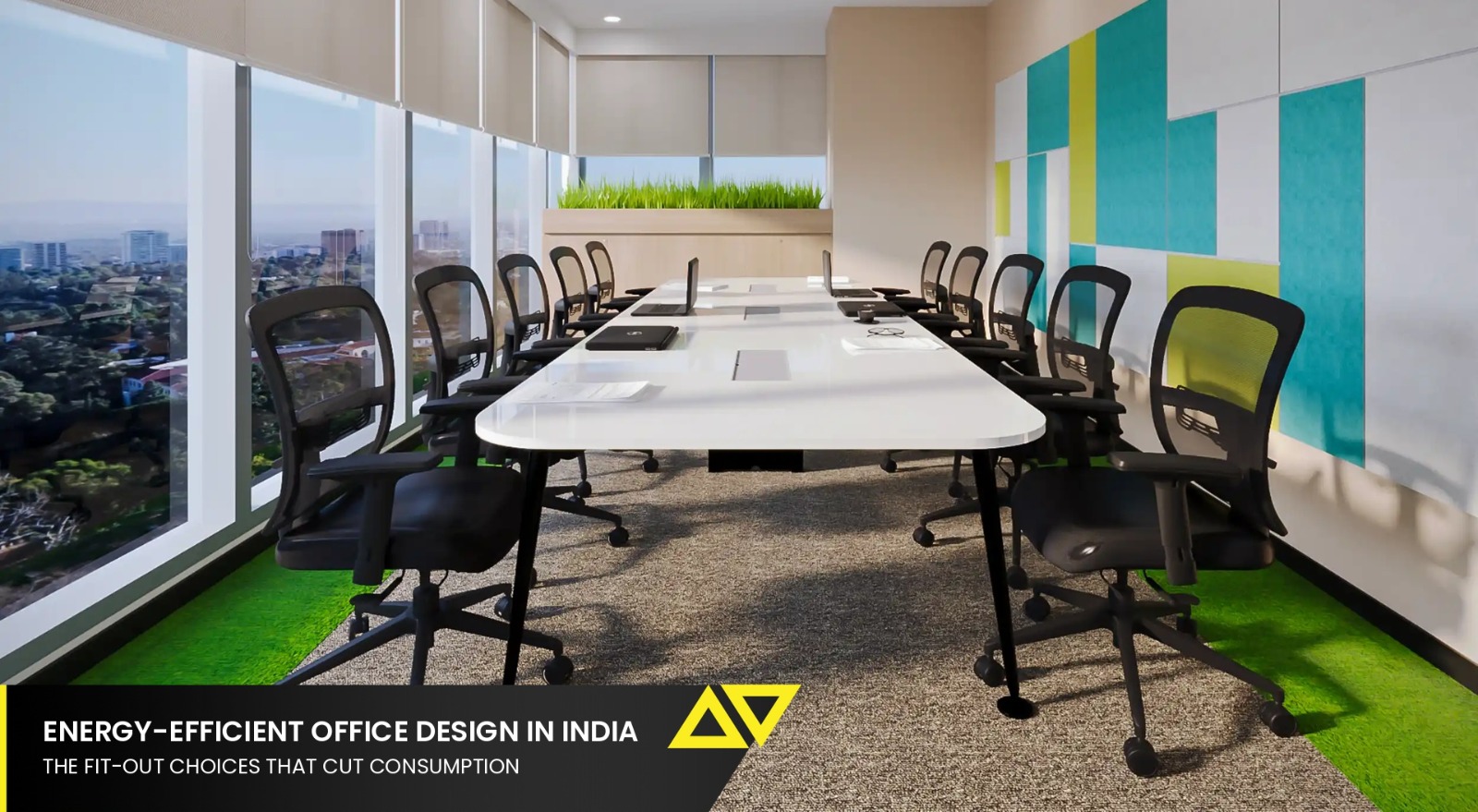
Energy conservation for office interiors is largely determined before the first workstation is installed. HVAC sizing, equipment selection, lighting and HVAC controls, and energy metering can lock in a floor’s operating costs for years. That gives you four decisions: how the loads are calculated, what equipment is selected, how it is controlled, and whether anyone measures the result. Ratings and certification are a separate conversation, because a floor can be energy-efficient without a plaque, and it can carry a plaque and still waste power for a decade.
The reason those four matter more than anything else is timing. All of them are made during the fit-out, and all of them are expensive to revisit afterwards. An oversized chiller is not a purchasing error you correct next year. It is a running cost you have committed to for the life of the equipment.
Key Takeaways
|
Where Energy Goes in an Indian Office
In many Indian offices, cooling is one of the largest energy loads, followed by lighting and plug and equipment loads. The exact mix varies by climate, occupancy, building envelope and HVAC system. That ordering matters because it tells you where attention is worth spending.
ECBC covers exactly this territory, setting requirements across the building envelope, HVAC, interior and exterior lighting, electrical systems and renewable readiness, and it does so across India’s five climate zones ECBC A fit-out in Chennai and one in Pune are solving measurably different problems with the same code.
Two things worth knowing about how that code reaches you. It applies to commercial buildings with a connected load of 100 kW or a contract demand of 120 kVA and above, which most office floors of any size will cross. And it becomes legally binding only once a state adopts it into its building rules, so the position varies by state and should be confirmed for your location rather than assumed either way
What the ordering also tells you is that finishes barely register. Choosing a lower-impact laminate is worth doing for other reasons. It will not show up on the electricity bill.
Load calculation, and the habit of sizing for a day that never comes
Almost every oversized system in India starts the same way. Cooling load gets calculated on the seat count the client hopes to reach, plus a safety margin, on the hottest conceivable day, with every meeting room full. The resulting equipment then spends its entire life running far below the load it was designed for, which is where most systems are least efficient.
The fix is unglamorous. Calculate from the occupancy you actually expect, count equipment heat honestly, and handle peak demand through staging rather than through one large machine. Multiple smaller units that step up as needed will beat one oversized unit on almost any real occupancy pattern, and they fail more gracefully.
This is also where capital and running cost pull against each other, and where a cheap tender price can be the expensive option. We set out how those numbers behave in office interior cost in India, city by city.
Choosing equipment: what star ratings do and do not tell you
This trips up a lot of briefs. BEE’s Standards and Labelling programme puts star ratings on room air conditioners, measured through the Indian Seasonal Energy Efficiency Ratio, which accounts for varying temperature across India’s climate zones and for operating hours. It has worked: government figures credit the programme with substantial efficiency improvement in split room air conditioners since it began.
Most offices, though, are not cooled by room air conditioners. They run VRF systems, ducted units or central chillers, and those are governed by ECBC performance requirements rather than by a yellow sticker. Asking a vendor for a five-star VRF is asking a question the label does not answer. The right question is what efficiency the system delivers at part load, because part load is where an office actually lives.
One more procurement trap. BEE revises star thresholds periodically, so a label only means something relative to its own validity period. Comparing a label issued in one period against one issued in another produces a conclusion that looks rigorous and is not.
Controls, and the quiet cost of things left on
Controls are often among the lower-cost energy-efficiency measures available during an office fit-out, and the first thing cut when a budget tightens. Of all the energy conservation techniques in interior office projects, they tend to return their cost the fastest. Daylight-linked dimming on the perimeter, presence detection in rooms and corridors, and HVAC scheduling that matches how the floor is actually occupied will each pay back faster than almost any equipment upgrade. They are also far cheaper to install during the fit-out than afterwards, which we cover in integrating smart office technology during a fit-out.
Before treating any of this as discretionary, check whether it already is not. Where ECBC applies, 90% of interior lighting fittings in a space larger than 300 sq m must carry an automatic control device, occupancy sensors are required in buildings above 20,000 sq m built-up area in defined space types, and perimeter zones within 4.5 m of windows need photosensor-based dimming with no permitted override. Controls are the line item most often value-engineered out of a budget, and on a large floor in a state that has notified ECBC, taking them out is not a saving. It is a compliance problem.
The failure mode is worth naming. Controls installed and then never commissioned properly get overridden by the first person who finds a room too dark, and then stay overridden. A control system nobody was trained on is a control system that is switched off.
Sub-metering, because you cannot manage what you cannot see
A single electricity bill for a floor tells you almost nothing. Separate metering for HVAC, lighting and equipment rooms turns that bill into something you can act on, and it is inexpensive at fit-out stage.
Give yourself a number to aim at as well, and make sure it is the right number. Energy Performance Index, measured in kWh per sq m per year, is the figure to track. Published research on Indian buildings puts offices commonly in the region of 55 to 80 kWh per sq m per year, and a warm-humid office built to Super ECBC performance at roughly 60. That is the territory a fit-out can move.
BEE’s Nearly Zero Energy Building threshold, an EPI below 15 kWh per sq m per year, is a genuine classification and is often quoted as a target. It is worth understanding what it measures before adopting it. The EPI in that definition is net annual consumption, meaning after on-site renewable generation is deducted, which is why the number is an order of magnitude below what a conventional office consumes. No combination of fit-out decisions gets a floor to 15. Substantial on-site generation does. Useful as a destination, misleading as a fit-out brief.
Retrofitting an occupied floor
Most energy work in India happens in buildings that are already running, with people in them, which changes the sequence rather than the principles.
- Meter before you touch anything. Without a baseline you cannot prove any of the work paid off, and the case for the next phase dies with it.
- Start with controls and settings, because they need no downtime and often deliver the first noticeable drop.
- Replace lighting next, zone by zone, in the evenings. It is the least disruptive equipment change and the easiest to reverse if something is wrong.
- Leave HVAC replacement until you have a season of metered data, so the new equipment gets sized on evidence rather than on the same optimistic assumptions as the old one.
- Recommission everything after the last change, since systems tuned around old equipment behave differently once it goes.
Retail fit-out, and choosing who does the work
The same techniques give different answers in a retail interior fit-out, because the load profile inverts. Display lighting dominates in a way it never does in an office, trading hours are longer, and door-opening heat gain is constant. Lighting control that would be sensible in an office can be commercially unacceptable on a shop floor, so the savings have to come from luminaire selection, better zoning of back-of-house, and entrance design instead.
Whoever you appoint, the energy question belongs in the selection conversation rather than after it. Ask how loads will be calculated and on whose assumptions, whether sub-metering is included as standard, who commissions the controls and trains your team, and what happens if the metered result misses the design intent. Interior fit out companies that can answer those four without hesitation are a different proposition from those who quote a rate per square foot. Our fit-out partner checklist goes further, and the argument for turnkey delivery applies here too, since the party that sized the system should be the party answerable for what it consumes.
Energy Conservation Techniques Worth Including in an Office Fit-Out
Ranked roughly by return on what they cost to include, these are the moves that make energy efficient interior design pay for itself.
| Technique | What it addresses | What it requires from the fit-out |
|---|---|---|
| Right-size the cooling | Equipment sized for a headcount you never reach runs inefficiently at part load for its whole life | Load calculated from your actual occupancy and equipment, not the landlord’s area assumption |
| Zone by how spaces are used | Meeting rooms, open floor and equipment rooms have completely different profiles | Separate zones and setpoints, so one does not pay for another |
| Daylight-linked lighting control | Perimeter lighting runs all day in a country with abundant daylight | Sensors and dimmable drivers specified at design stage, not retrofitted |
| Occupancy control everywhere | Empty rooms stay lit and conditioned, especially outside core hours | Presence detection on rooms, corridors, washrooms and pantries |
| Sub-meter the big loads | A single bill cannot tell you which system is drifting | Separate metering for HVAC, lighting and equipment rooms at minimum |
| Plan for measurement | Systems commissioned once and never checked return to defaults | A named owner and a quarterly read of the EPI figure |
Planning a fit-out with consumption in mind?
|
Frequently Asked Questions